

Understanding Redox Potential in RAS
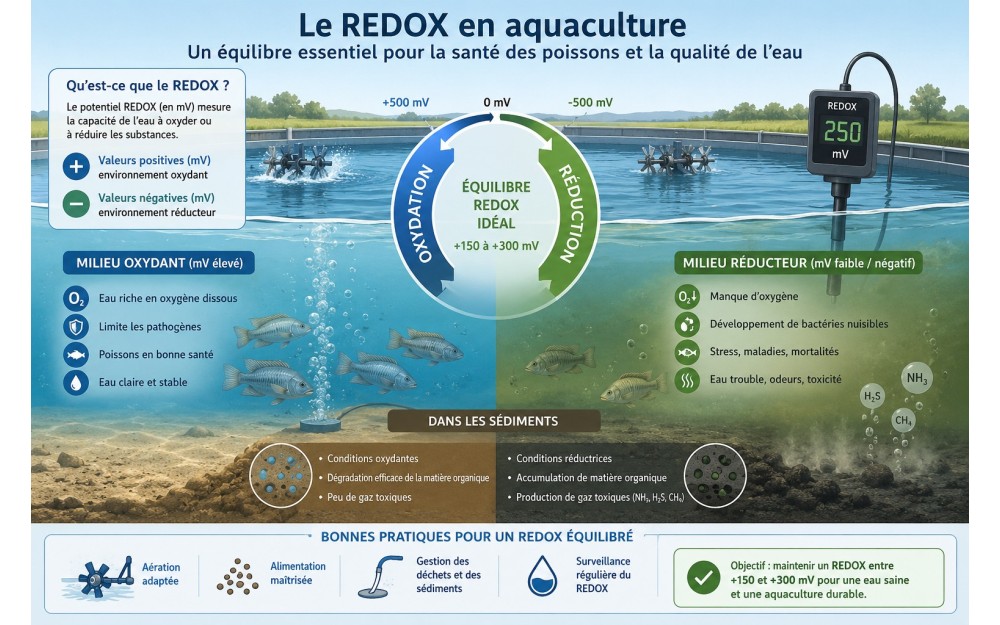
Redox potential is one of the most commonly measured parameters in aquaculture—and probably one of the least understood. Included on many multiparameter probes, it is often reduced to a simple millivolt value that is difficult to interpret and rarely used to its full potential.
Why Consider Redox Potential?
Modern aquaculture systems, whether open-flow systems, Recirculating Aquaculture Systems (RAS), hatcheries, or extensive ponds, are complex biological environments.
Oxygen, bacteria, organic matter, nitrogen compounds, and cultured organisms continuously exchange electrons. Redox potential (ORP) is one of the few measurements capable of reflecting this dynamic.
However, the raw ORP value is difficult to interpret because it depends on many factors:
- pH;
- temperature;
- salinity;
- the type of electrode used;
- the chemical equilibria present in the water.
Using only a value expressed in millivolts often means observing a complex phenomenon through a single indicator that, while reliable, remains insufficiently corrected.
Describing How the System Functions Rather Than Measuring a Single Potential
A more meaningful approach is to consider culture water as a living, dynamic system in which electron exchanges reflect biological activity.
The objective is not to search for an "ideal" Redox value, but rather to characterize the overall state of the aquatic environment.
This approach combines several parameters already measured in most aquaculture facilities:
- Redox potential (ORP);
- pH;
- temperature;
- conductivity or salinity;
- dissolved oxygen;
- oxygen saturation.
Linking Chemistry and Biology
One of the most promising approaches is to integrate dissolved oxygen data with Redox indicators.
The objective is to develop indices capable of representing:
- the intensity of biological respiration;
- the chemical stability of the system;
- the ability of the environment to absorb an increase in organic loading;
- the overall level of biological activity.
This approach goes beyond simple water quality monitoring. It opens the way to a truly predictive assessment of the ecological balance of aquaculture systems.
A Resilience Index for Aquaculture Systems
If the indicator proves sufficiently robust, it will become possible to quantify not only the current state of the environment but also its ability to withstand disturbances.
The combined analysis of Redox potential, dissolved oxygen, and their stability over time makes it possible to identify these differences.
Simplifying the work of aquaculture producers and aquarium managers requires the development of an intuitive graphical representation capable of rapidly visualizing the biological functioning of the water body (tank, pond, or aquarium).
Rather than multiplying numerical values, the goal is to position each system within a biological state space such as:
- Oligotrophic water;
- Optimal biological performance;
- High bacterial activity;
- Organic overload;
- Fermentation;
- Anaerobic conditions.
Redox potential can become much more than a number displayed on a probe. When correctly interpreted, it may become one of the most valuable indicators for the biological management of tomorrow's RAS aquaculture systems.