

Biomedia in recirculating aquaculture (RAS)
The choice of biomedia is a central element in the design of a biological filter in a recirculating aquaculture system (RAS – Recirculating Aquaculture System). The biological filter ensures nitrification, that is, the conversion of ammonia (NH₃/NH₄⁺), which is toxic to fish, into nitrites (NO₂⁻), and then into nitrates (NO₃⁻), which are less toxic. This transformation is carried out by autotrophic nitrifying bacteria, mainly Nitrosomonas and Nitrobacter, which colonize all available surfaces within the biofilter.
Biomedia serves as a physical support for the development of bacterial biofilm. Its effectiveness mainly depends on its specific surface area, expressed in m² of surface per m³ of media. The higher this surface area, the greater the theoretical nitrification capacity. In practice, the truly active surface also depends on porosity, oxygen accessibility, and hydraulic circulation.
Two major families of biomedia can be distinguished:
-
Fixed media (submerged bed, trickling filter). Fixed media, often made of structured plastic materials or porous mineral supports, provide high stability but may be prone to clogging if upstream mechanical filtration is insufficient.
-
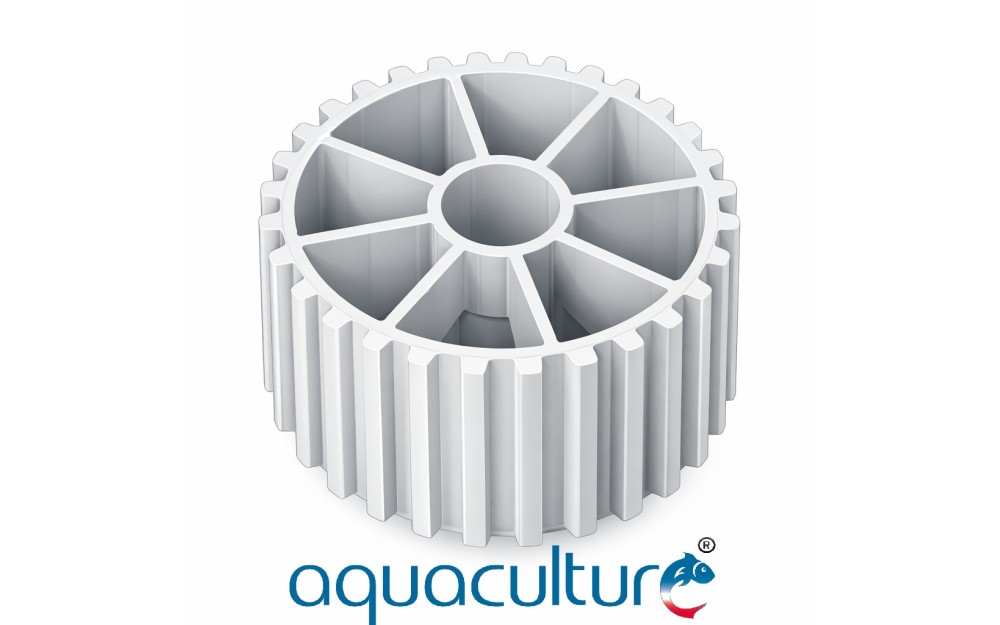
Moving media (Moving Bed Biofilm Reactor – MBBR). Moving media, such as those used in MBBR systems, are kept in motion by strong aeration, allowing partial self-cleaning of the biofilm and limiting excessive accumulation of organic matter.
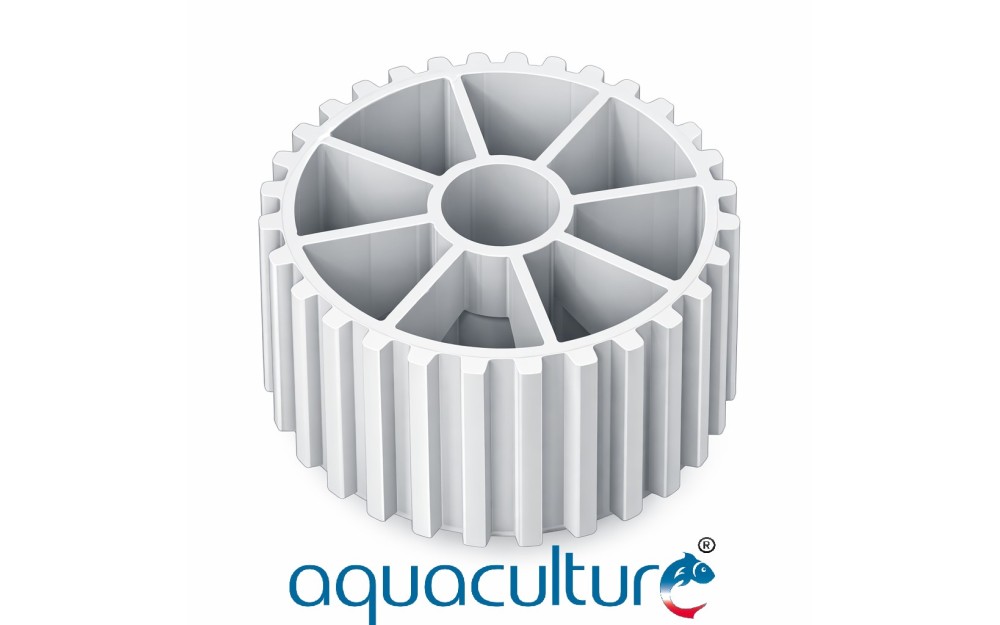
These include MBBR-type media, as well as biochips, and highly specific media such as MUTAG or LEVAPOR.
The fundamental criterion remains the volumetric nitrification capacity, generally expressed in g NH₄-N oxidized per m³ of media per day. This value depends on temperature, pH, dissolved oxygen concentration, and available alkalinity. In intensive aquaculture, the biofilter is often sized based on the nitrogen load derived from distributed feed, considering that approximately 25 to 35% of ingested protein nitrogen is excreted as ammonia.
The biomedia material must be chemically inert and resistant to UV radiation, pH variations, and mechanical stress. Engineering polymers (HDPE, PP) are commonly used for their durability and chemical neutrality. Mineral media (pumice, ceramics) have high porosity but clog more easily. Being heavier and less mobile, their use influences the structural design of the filter.
The geometry of the biomedia also plays a key role. Fin structures, honeycomb shapes, or perforated wheels increase specific surface area while promoting mixing and oxygenation. In heavily loaded systems, moving media with high protected surface area (internal surfaces sheltered from shear forces) allow maintenance of stable bacterial biomass even under variable hydraulic conditions.
The reactor filling rate directly influences performance. In MBBR systems, 40 to 70% of the reactor volume is typically occupied by media to ensure proper agitation. Excessive media reduces mobility and therefore oxygen transfer efficiency.
Oxygenation is a critical parameter: nitrification consumes approximately 4.57 g of oxygen per gram of ammoniacal nitrogen oxidized. Biomedia must therefore allow efficient oxygen diffusion to the biofilm. Poor hydraulic design can create anoxic zones that promote denitrification or the production of undesirable compounds.
The final choice of biomedia must integrate economic considerations: cost per m³, lifespan, ease of installation, maintenance, and local availability. Compatibility with the overall RAS strategy must also be evaluated: recirculation flow rate, daily feed load, stocking density, and desired safety level.
There is no ideal biomedia. The selection must represent an optimized compromise between usable specific surface area, clogging resistance, hydraulic efficiency, and operating cost. Rigorous sizing based on the actual nitrogen load remains essential to ensure biological stability of the system and fish health.