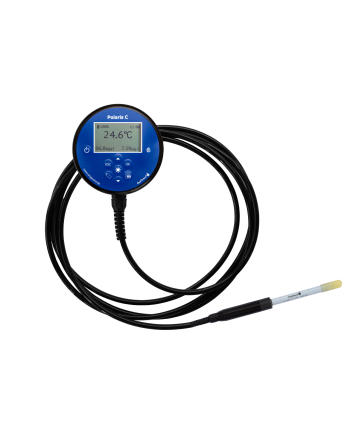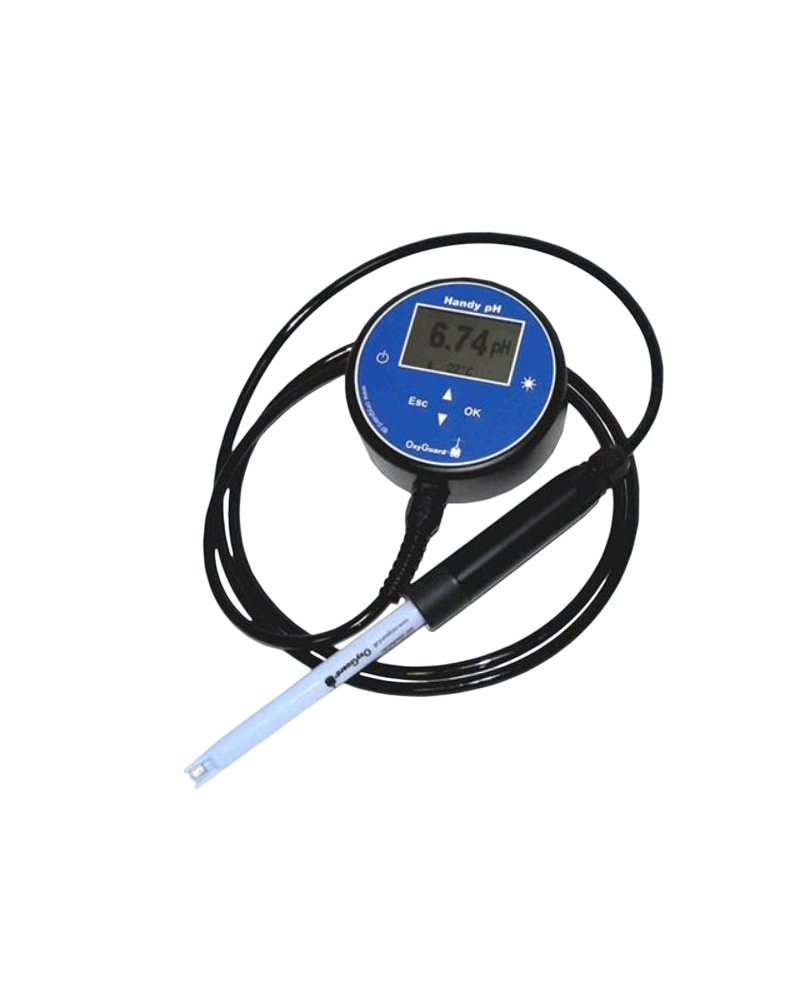
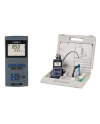


A redox meter (or ORP meter, Oxidation-Reduction Potential meter) is a measuring device used in aquaculture to monitor the redox state of water, expressed in millivolts (mV).
Principle:
The redox meter measures the oxidation-reduction potential (Eh) of water, i.e. the overall tendency of the medium to be oxidizing (positive values) or reducing (negative values).
It works with a platinum electrode (sensitive to redox reactions) combined with a reference electrode (often Ag/AgCl).
Components:
Probe with measuring electrode and reference electrode.
Electronic unit with digital display showing values in mV.
Some models include data logging, alarms, or connectivity (Bluetooth, RS232, etc.).
Measuring range: usually -1000 to +1000 mV, with accuracy of ±1–2 mV.
A redox meter (or ORP meter, Oxidation-Reduction Potential meter) is a measuring device used in aquaculture to monitor the redox state of water, expressed in millivolts (mV).
Principle:
The redox meter measures the oxidation-reduction potential (Eh) of water, i.e. the overall tendency of the medium to be oxidizing (positive values) or reducing (negative values).
It works with a platinum electrode (sensitive to redox reactions) combined with a reference electrode (often Ag/AgCl).
Components:
Probe with measuring electrode and reference electrode.
Electronic unit with digital display showing values in mV.
Some models include data logging, alarms, or connectivity (Bluetooth, RS232, etc.).
Measuring range: usually -1000 to +1000 mV, with accuracy of ±1–2 mV.
| Models | 1 | 2 | 3 |
| Name | OxyGuard Redox (*) |
WTW 3110 pH/Redox (**) | WTW-3310 (**) |
| Reference | P0044100 | P0046100 | P0048100 |
| pH | -1 ... 15 | -2.0...20.0 | -2.0...20.0 |
| °C | 0....+50 | -5.0....105.0 | 5.0....105.0 |
| Redox | +/- 1500 mV | +/-12000.0 mV +/-2000 mV | +/-12000.0 mV +/-2500 mV |
| Câble | 1.5 m | 1 m | 1 m |
| Size(mm) | 300-230-50 | 365-320-130 | 365-320-130 |
| Weight (kg) | 0.7 | 0.7 | 0.65 |
|
(*) Device with redox probe and accessories in a case, pH probe not included, to be ordered separately. (**) Device with pH and redox measurement in a set with hard case. |
|||
Water quality: The redox potential reflects the overall balance between oxidizing substances (dissolved oxygen, nitrates) and reducing ones (organic matter, sulfides, ammonium).
Oxygenation: High values (> +300 mV) indicate well-oxygenated water, favorable for fish.
Organic load: Lower potential (< +200 mV) signals accumulation of organic waste or oxygen depletion.
Anaerobic zones: Values near 0 mV or negative indicate reducing conditions (H₂S, methane production), harmful for aquaculture.
Monitoring fish ponds, tanks, and recirculating aquaculture systems (RAS).
Assessing sediments in feeding areas (detection of anoxic conditions).
Combined with dissolved oxygen measurements for a more precise evaluation of the aquatic environment.
You might also like