

Carbon Dioxide in Aquaculture: The Silent Killer
In a Recirculating Aquaculture System (RAS), fish farmers naturally focus on the most immediate parameters: clear water, dissolved oxygen levels close to saturation, and ammonia and nitrite concentrations effectively controlled by the biofilter. However, an invisible and silent danger frequently threatens intensive fish farming operations, particularly salmonid production: the accumulation of dissolved carbon dioxide (CO₂).
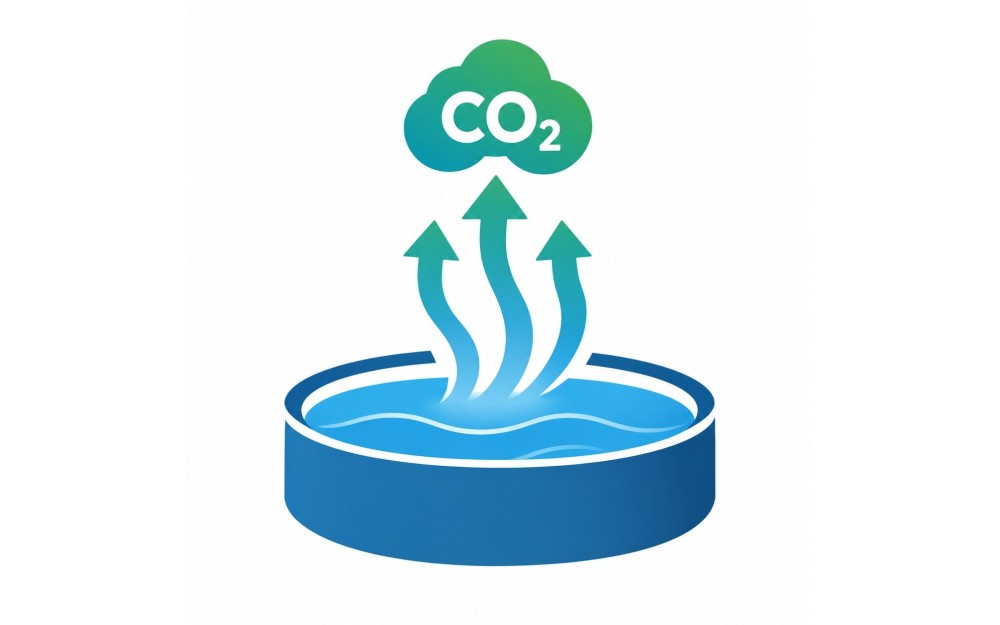
Continuously generated by fish respiration and the biological activity of nitrifying bacteria, CO₂ accumulates at critical rates as water recirculation rates increase. All too often, the technical mistake is to respond to respiratory stress in fish by increasing oxygenation. Yet the solution is counterintuitive: saturating water with pure oxygen does not remove carbon dioxide. Fish can die from hypercapnia or develop severe nephrocalcinosis in water that is nevertheless enriched to 120% oxygen saturation.
Understanding CO₂ dynamics, controlling its impact on pH, and designing mechanically efficient stripping degassing units adapted to your fish biomass are not optional comfort features: they are essential foundations for the success of your production facility.
I. Fish physiology and CO₂: biological risks
In recirculating aquaculture systems (RAS), carbon dioxide (CO₂) accumulation is one of the consequences of increasing biomass and reducing fresh water intake. For every kilogram of oxygen consumed by fish, an average of 1.3 to 1.4 kg of CO₂ is produced. If this gas is not removed from the water at the same rate at which it is generated, it crosses the gill barrier and profoundly affects fish physiology.
Hypercapnia and the Root effect
An increase in dissolved CO₂ in water reduces the partial pressure gradient between the fish's blood and its environment. CO₂ accumulates in the animal's bloodstream, a condition known as hypercapnia. This phenomenon causes acidification of the blood plasma (respiratory acidosis).
In fish, particularly salmonids, this decrease in blood pH triggers a critical physiological phenomenon known as the Root effect. Unlike the Bohr effect (which reduces haemoglobin's affinity for oxygen), the Root effect goes further: it reduces the maximum oxygen-binding capacity of haemoglobin, even when the surrounding water is saturated with oxygen. The fish consequently develops internal tissue hypoxia.
The behavioural symptoms are unmistakable: lethargy, loss of appetite, reduced feed conversion efficiency and increased susceptibility to opportunistic infections.
Nephrocalcinosis: the point of no return
The most insidious risk associated with chronic exposure to high CO₂ concentrations (generally from 15 to 20 mg/L) is nephrocalcinosis.
To compensate for blood acidosis, fish attempt to regulate their internal pH by retaining bicarbonate ions and excreting calcium and phosphate through the kidneys.
This abnormal concentration of minerals in the kidneys causes calcium phosphate crystals to precipitate. The fish's kidneys become calcified, swell and suffer irreversible damage. Nephrocalcinosis permanently impairs the animal's osmoregulatory capacity.
A batch of juveniles affected by nephrocalcinosis in a hatchery may experience massive mortality during subsequent grow-out stages.
Critical thresholds in intensive production
Sensitivity varies according to species and developmental stage, but established recommendations for RAS impose the following limits:
- Hatcheries and nurseries (salmonids): < 10 mg/L (larval stages and first-feeding stages being the most vulnerable).
- Grow-out (salmonids): < 15 mg/L maximum.
- More tolerant species (sea bass, sea bream, tilapia): < 20 to 25 mg/L, although optimal performance is consistently observed below 15 mg/L.
II. Water chemistry balance: the pH / Alkalinity / CO₂ triangle
To control CO₂ in a recirculating system, it cannot be considered as an isolated gas. As soon as carbon dioxide dissolves in water, it chemically interacts with H₂O molecules to form the total inorganic carbon (TIC) system. This system relies on a dynamic equilibrium between three levels.
The central role of pH
The proportion of each chemical form depends almost exclusively on water pH:
- At a pH below 5, carbon is present almost entirely in its gaseous form (CO₂).
- At a pH of 6.3, equilibrium is reached: 50% gaseous CO₂ and 50% bicarbonate ions (HCO₃⁻).
- Between pH 7 and 8.5 (the target range in aquaculture), most carbon is converted into bicarbonate ions, which are not toxic to fish.
In RAS, biofilter nitrifying bacteria consume significant amounts of carbonate to oxidise ammonia into nitrate, releasing hydrogen ions (H⁺) and causing pH to decrease.
For example, if pH drops from 7.5 to 6.8, a substantial proportion of harmless bicarbonates can be converted into free, gaseous and highly toxic CO₂, even without any increase in fish respiration.
TAC management (alkalinity): the essential buffer
Alkalinity (or Total Alkalinity) represents the water's ability to neutralise acids, in other words, its buffering capacity.
In RAS, to maintain a stable pH (around 7.2 to 7.5) and prevent bicarbonates from converting into free CO₂, operators must compensate for biofilter consumption by adding an alkaline substance (sodium bicarbonate, sodium hydroxide or lime).
However, increasing alkalinity without having a physical gas extraction system is only a short-term solution. The water will accumulate an enormous quantity of inorganic carbon.
At the slightest disturbance or decrease in pH, this reservoir can be released in the form of free CO₂, triggering a sudden and severe hypercapnia crisis in the tanks.
Water chemistry (TAC/pH management) and physics (mechanical gas extraction) are therefore two sides of the same coin.
Oxyguard-tgp-total-gas-pressure
III. Why oxygenation alone is a technical and physical mistake
When faced with a group of fish showing signs of respiratory stress, many operators' first instinct is to open the pure oxygen supply valves.
Although this action can temporarily mask symptoms by increasing the partial pressure of O₂ in the blood, it is based on a misunderstanding of gas physics and ultimately proves counterproductive.
Dalton's law and the independence of partial pressures
Gas dissolution and release in water are governed by physical laws, particularly Dalton's law.
According to these principles, each gas dissolves into or escapes from water according to its own partial pressure gradient between the liquid and gaseous phases, independently of the other gases present.
In practical terms, saturating or even supersaturating water to 150% or 200% with pure oxygen (using oxygen cones or microbubble diffusers) has absolutely no effect on CO₂.
CO₂ molecules remain in the water.
Injecting pure oxygen does not create the gas volume or active exchange surface required to allow carbon dioxide to escape from the liquid phase.
This can lead to the paradoxical – and potentially fatal – situation of raising fish in highly oxygenated water that is nevertheless saturated with toxic free CO₂.
The microbubble confinement trap
Intensive use of oxygen diffusers in tanks without an external extraction system makes the situation worse.
The absence of coarse air bubbles (which create mixing and disrupt surface tension at the water surface) leaves the water in a state where volatile gases cannot escape efficiently.
To remove CO₂, a sufficient gas volume is required, and more specifically, air.
The solution?