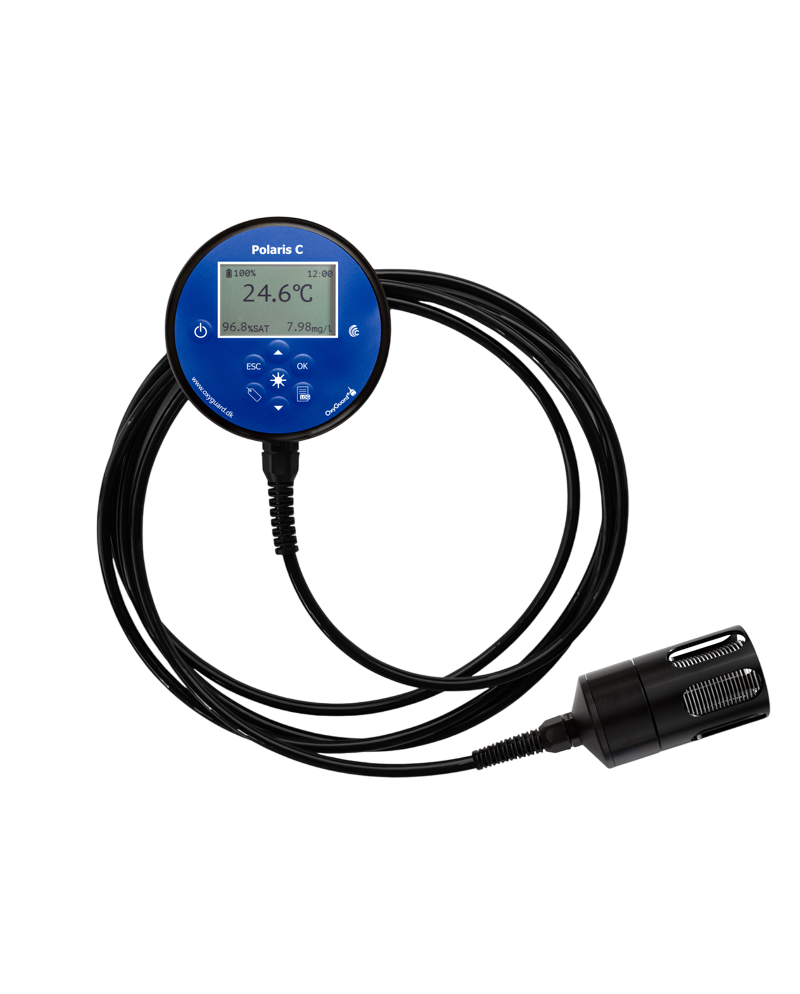


The OxyGuard TGP probe is a sensor designed to measure the total dissolved gas pressure in water (i.e. the sum pressure of all dissolved gases) together with water temperature.
It’s intended for use with OxyGuard monitoring systems (e.g. OxyGuard “Commander” or “Pacific”) and can be added to existing setups.
The system also uses a dissolved-oxygen (DO) probe placed near the TGP probe to allow computation of gas saturation degrees: for total gas, for oxygen specifically, and for “other gases” (mainly nitrogen) in the water
The OxyGuard TGP probe is a sensor designed to measure the total dissolved gas pressure in water (i.e. the sum pressure of all dissolved gases) together with water temperature.
It’s intended for use with OxyGuard monitoring systems (e.g. OxyGuard “Commander” or “Pacific”) and can be added to existing setups.
The system also uses a dissolved-oxygen (DO) probe placed near the TGP probe to allow computation of gas saturation degrees: for total gas, for oxygen specifically, and for “other gases” (mainly nitrogen) in the water
From the specifications and user manual:
The probe has two internal sensors: one for dissolved gas pressure and one for temperature.
The system obtains the residual gas pressure (i.e. non-oxygen gases) by subtracting the oxygen partial pressure (measured by the DO probe) from the total dissolved gas pressure.
It can display results in different modes:
Because gas diffusion in water is slow, readings may require letting the probe equilibrate in moving water (5–10 cm/s flow is recommended) and waiting until stable readings before logging.
Calibration is done typically in air; the TGP probe is calibrated by placing it in air and running an automatic calibration routine via the control system (e.g. Commander or Pacific).
Compensation for CO₂ dissolved in water and water vapor pressure can be enabled (for more accurate residual gas estimates).
Fish farming / aquaculture: measuring total dissolved gas pressure is important to detect supersaturation to avoid gas bubble disease in fish.
Knowing the degree to which water is saturated with gases (O₂ + other gases) helps in system control, aeration, degassing, and water quality management.
The ability to discern oxygen vs residual gases gives better insight into gas dynamics in water under variable conditions (e.g. during aeration or changes in pressure).
The probe is modular: sensor elements can be replaced if fouling or damage occurs.
It integrates directly with OxyGuard monitoring systems without requiring separate transmitters — communicates via field bus to the system