


Heat Exchanger on a Skid: A Compact Plug & Play solution
In aquaculture and aquarium facilities, controlling water temperature is an essential factor in ensuring animal welfare and system stability.
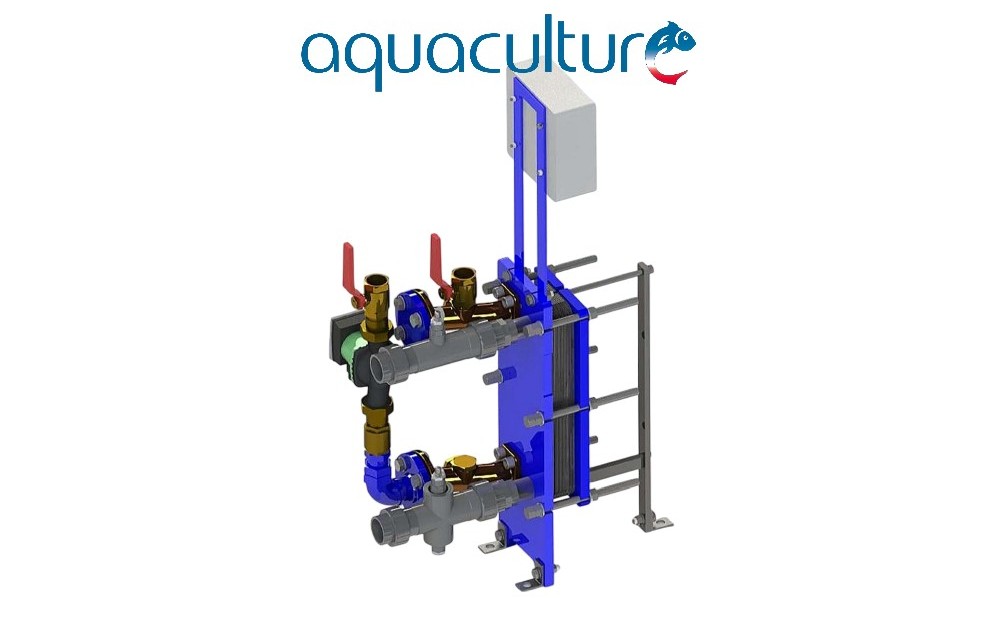
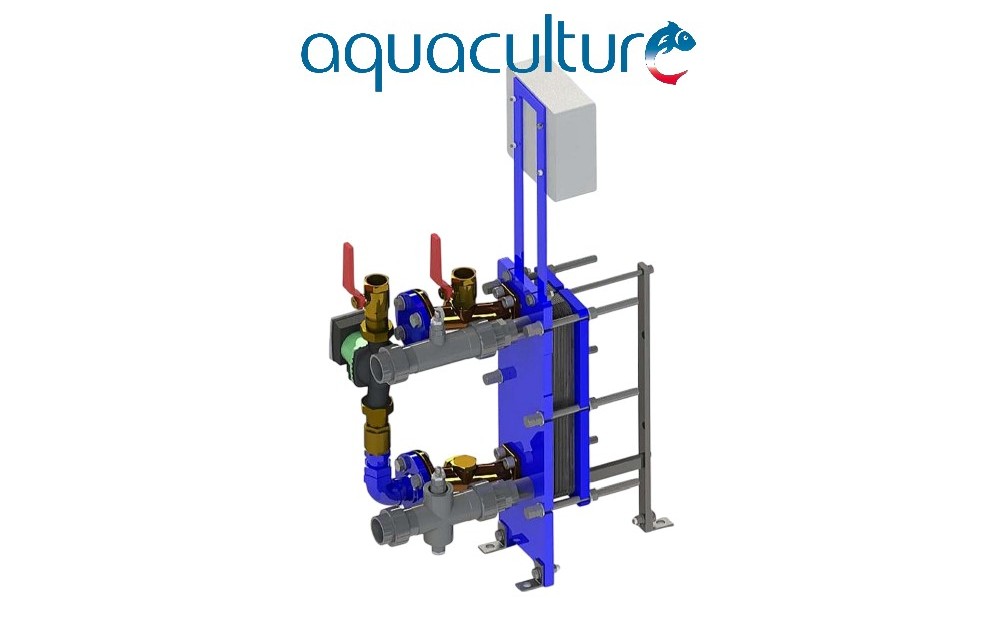
To meet the constraints encountered in the field, Aquaculture France has developed and installed a complete heat exchanger mounted on a stainless-steel skid, designed as a compact, integrated and immediately operational solution.
The objective of this development is simple: to bring together, within a single unit, all the components required for the control and circulation of the thermal circuit.
The skid incorporates the heat exchanger, circulation pump, temperature sensors, display and a controller for regulating and controlling the system.
This plug-and-play design significantly reduces on-site installation work and simplifies commissioning.
The stainless-steel frame provides a robust and durable solution, particularly well suited to humid environments.
One of the main advantages of this configuration is its compact footprint.
Technical facilities in fish farms, hatcheries, laboratories, public aquariums and research facilities are often designed around equipment that is already in place. As a result, there is often little space available to add a conventional heating or cooling system.
In some buildings, access routes are also narrow, ceiling heights are limited, or the available space is simply unsuitable for installing large equipment.
The skid addresses these constraints by providing a pre-assembled, compact unit that can be easily integrated into an existing technical room.
Centralising the components also makes maintenance and troubleshooting easier by bringing the main operating components together on a single support frame.
This approach also helps reduce the length of piping and cabling required between the different components.
For renovation or upgrade projects involving existing facilities, this solution can be particularly relevant.
It can, for example, add heating or cooling capacity without requiring major modifications to the building or technical room.
The concept can also be adapted to the specific requirements of each installation, including thermal capacity, heat exchanger type, circulation flow rate, instrumentation and control logic.