

Understanding the Off-Flavor Phenomenon in RAS Systems
The development of Recirculating Aquaculture Systems (RAS) represents a major advancement in reducing water consumption, improving biosecurity, and increasing production intensity. However, these systems face a recurring challenge: the occurrence of undesirable tastes and odors in fish flesh, commonly referred to as off-flavor.
This issue particularly affects salmonids, tilapia, percids, and other species reared in closed-loop systems.
What is Off-Flavor?
Off-flavor generally refers to taste and odor notes described as earthy, muddy, or musty. It is often referred to as a “pond taste.”
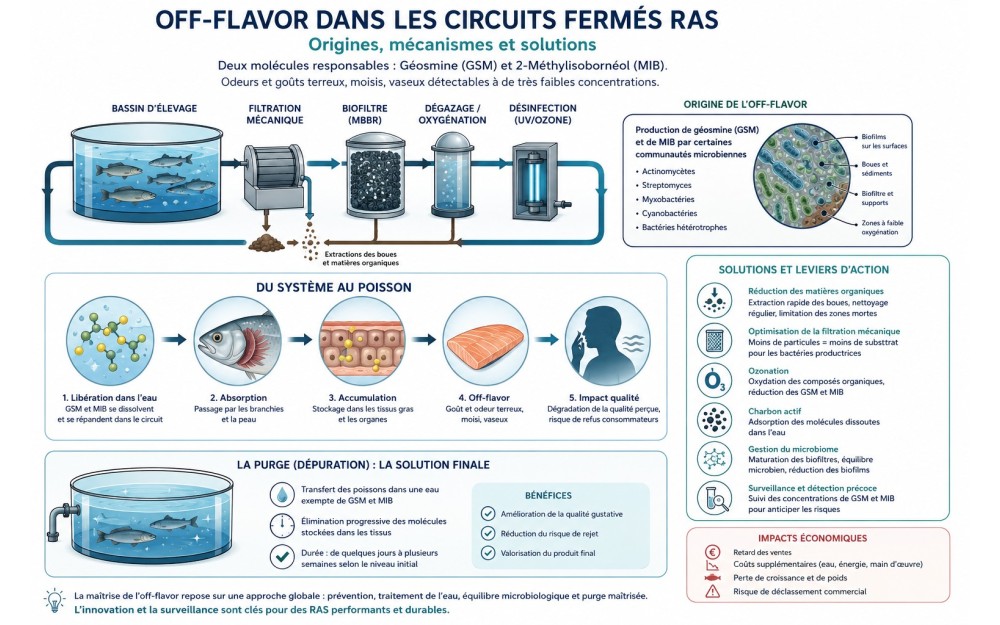
The main compounds responsible are:
- Geosmin (GSM), a molecule naturally produced by certain microorganisms.
- 2-Methylisoborneol (MIB), a compound closely related to geosmin that generates particularly pronounced musty odors.
These substances can be detected by humans at extremely low concentrations, sometimes below one nanogram per gram of fish flesh.
Where Do Geosmin and MIB Come From in RAS?
Contrary to common belief, biofilters are not the sole source.
Studies show that the main production sites are often:
- Thick biofilms;
- Accumulations of organic matter;
- Settling tank sludge;
- Certain areas of mechanical treatment systems;
- Biological compartments rich in organic carbon.
The microorganisms most frequently involved include:
- Actinomycetes;
- Streptomyces;
- Myxobacteria;
- Certain cyanobacteria;
- Various heterotrophic bacteria.
Why Does RAS Promote This Phenomenon?
RAS is a highly dense microbiological ecosystem.
Factors that favor the occurrence of off-flavor include:
- High organic loading;
- Accumulation of suspended solids;
- Biofilm development;
- Low-oxygen zones;
- Microbiologically unstable biofilters;
- Newly commissioned systems.
A recent study conducted on Atlantic salmon showed that systems with a mature microbial community contained significantly lower levels of geosmin and MIB than recently started systems.
Economic Consequences
The economic impact can be considerable:
- Delayed sales;
- Occupation of production tanks;
- Additional water consumption;
- Growth loss during depuration;
- Risk of product downgrading;
- Damage to brand image.
In some farms, the depuration phase can last several weeks.
Currently Available Solutions
1. Purging or Depuration
This is currently the most reliable method.
Fish are transferred to water free of geosmin and MIB, allowing these compounds to gradually diffuse out of the tissues.
Several drawbacks exist, including long treatment times, high costs, and fish weight loss.
2. Reduction of Organic Matter
Studies consistently agree on one point: the less organic matter accumulates, the fewer geosmin-producing bacteria develop.
For every RAS facility, this means implementing solutions for rapid sludge removal, optimizing mechanical filtration, regularly cleaning circuits, and minimizing dead zones.
3. Ozonation
Ozone can oxidize part of the organic compounds and limit certain microbial populations.
Results are promising but remain variable depending on the facility. Ozonation alone generally does not completely eliminate the need for depuration.
4. Activated Carbon
Activated carbon can adsorb part of the dissolved geosmin and MIB present in the water.
This solution is effective but involves replacement and maintenance costs.
5. Advanced Oxidation Processes
Current research is focusing on:
- Ozone + hydrogen peroxide;
- Photocatalysis;
- Advanced UV treatments.
These approaches aim to directly degrade the molecules responsible for off-flavor.
What We Are Developing
We are currently working on the optimized use of ozone as a tool for controlling off-flavor.
The objective is to determine whether precise ozone management—or more specifically micro-ozonation—can sufficiently reduce geosmin and MIB concentrations to shorten depuration periods.
At this stage, the question remains unresolved, but every step forward is valuable.
This approach is particularly interesting because it seeks to address the problem at its source, directly within the system water, rather than at the fish level at the end of the production cycle.
Future Perspectives
Current research trends suggest that the solution will likely not rely on a single technology.
The most efficient RAS systems of tomorrow will probably combine:
- Strict organic matter management;
- More microbiologically stable biofilters;
- Continuous monitoring of GSM and MIB concentrations;
- Better-designed oxidation strategies;
- Rapid detection technologies capable of anticipating risks before they affect fish quality.
Conclusion
Off-flavor is not merely a sensory issue; it is a major technical, economic, and commercial challenge for RAS operations.
Recent advances indicate that improved control of the system microbiome, combined with targeted water treatment technologies, may ultimately reduce the costs associated with depuration phases and improve the final quality of fish produced in recirculating aquaculture systems.