


Mass balances in RAS: a central tool for design and management
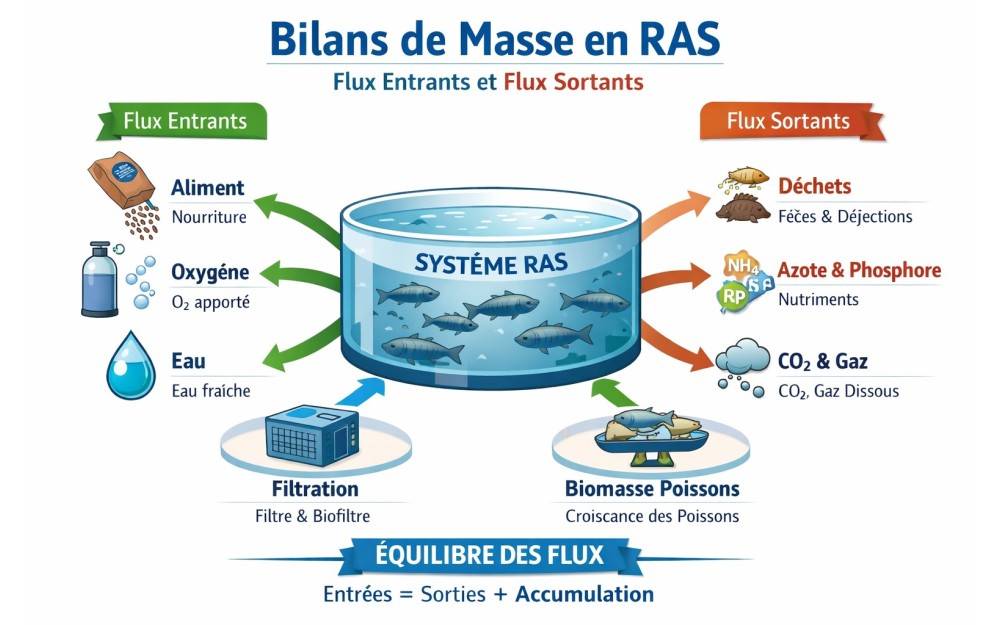
In recirculating aquaculture systems (RAS), controlling material flows is a fundamental challenge. The mass balance therefore stands out as an essential tool, both for designing an efficient system and for ensuring its day-to-day management.
The principle is simple: everything that enters the system must either leave it or accumulate within it.
Applied to a RAS, this mainly concerns feed input, fish biomass, solid waste, nitrogen and phosphorus compounds, as well as gas exchanges.
Feed represents the main material input. A fraction is converted into fish biomass, but a significant portion is released as feces or dissolved excretions. These outputs form the basis of the flows that must be treated within the system.
Mass balance thus makes it possible to accurately estimate waste production. For example, it allows quantification of suspended solids, ammonia nitrogen, and total phosphorus produced per kilogram of feed distributed.
This information is essential for sizing equipment. The mechanical filter must be able to capture the produced solids, while the biofilter must treat the nitrogen load resulting from fish excretion.
Without a mass balance, system design relies on approximations. In contrast, a rigorous approach helps optimize filtration volumes, recirculation flow rates, and energy consumption.
Mass balance is also a key tool for anticipating system deviations. An increase in solid waste may indicate overfeeding or poor feed digestibility. Similarly, nitrogen accumulation may reveal a malfunction of the biofilter.
From a management perspective, it links farming practices to system performance. Adjustments in feeding rates, stocking densities, and feed selection can thus be guided by quantified indicators.
This tool becomes even more critical in a context of aquaculture intensification. Margins for error are reduced, and the ability to predict flows becomes essential to ensure water quality and fish health.
Mass balance also fits within an environmental approach. It allows evaluation of system-level discharges and identification of reduction strategies, particularly through improved feed efficiency or effluent valorization.
During the design phase, it serves as a foundational framework. It enables comparison of different production scenarios, estimation of treatment needs, and validation of technical choices.
During operation, it becomes a monitoring tool. Combined with regular measurements, it helps verify consistency between theoretical flows and field observations.
Finally, mass balance promotes a systemic approach to RAS. Rather than considering each component in isolation, it encourages understanding of interactions between feeding, fish metabolism, water treatment, and waste production.
In conclusion, mass balance is not just a calculation tool: it is a true decision-support tool. When properly applied, it enhances technical, economic, and environmental performance in RAS systems.