



Magnetic Drive Pumps in Aquaculture
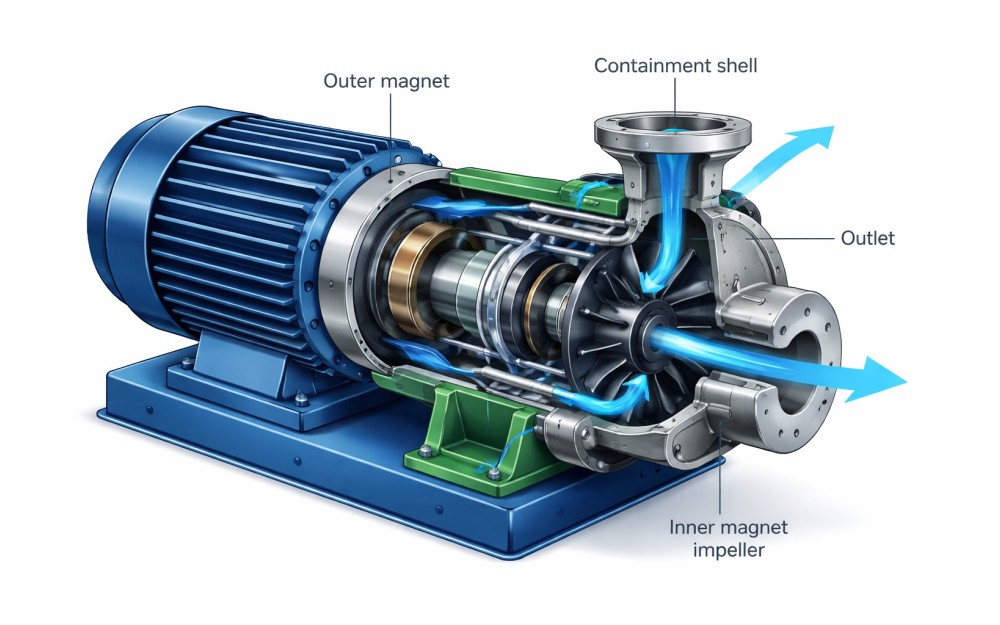
The use of magnetic drive pumps (also called magnetically coupled pumps) offers several significant advantages in aquaculture, especially in systems where water quality and biosecurity are critical.
1. No mechanical seal = zero leakage
Unlike conventional pumps, there is no shaft passing through a mechanical seal to connect the impeller to the motor. The motor drives the impeller via a magnetic field, without direct contact.
Advantages:
-
No risk of leakage at the pump/motor coupling
-
No air entering the suction line
-
No possible contamination at the coupling
-
Increased safety for demanding processes (seawater, corrosive fluids, etc.)
In aquaculture, using this type of pump reduces sanitary risks and improves process reliability.
2. Reliability and biosecurity
In intensive or recirculating systems (RAS), magnetic drive pumps reduce the number of critical points and limit intrusive maintenance.
3. Reduced mechanical wear
This type of pump has no friction at a rotating seal. This configuration reduces wear and significantly decreases preventive maintenance operations.
4. Excellent compatibility with saline or aggressive water
Magnetic pumps are manufactured from composite materials (polypropylene or PVDF).
These corrosion-resistant materials are particularly well suited for seawater, loaded effluents, or corrosive solutions (acidic or alkaline disinfectants).
5. Quieter operation
The absence of a rotor reduces vibrations, lowering noise levels in technical rooms and limiting vibration transmission into the water. This helps reduce stress in fish.
6. Limitations to consider
These pumps are not always ideal. If the pumped fluid contains a high amount of solids, the risk of clogging cannot be ruled out.
The cost of the technology becomes particularly significant when high flow rates are required.
Energy efficiency is often slightly lower than that of conventional centrifugal pumps.