

Protein Skimming in Aquaculture and Aquariology
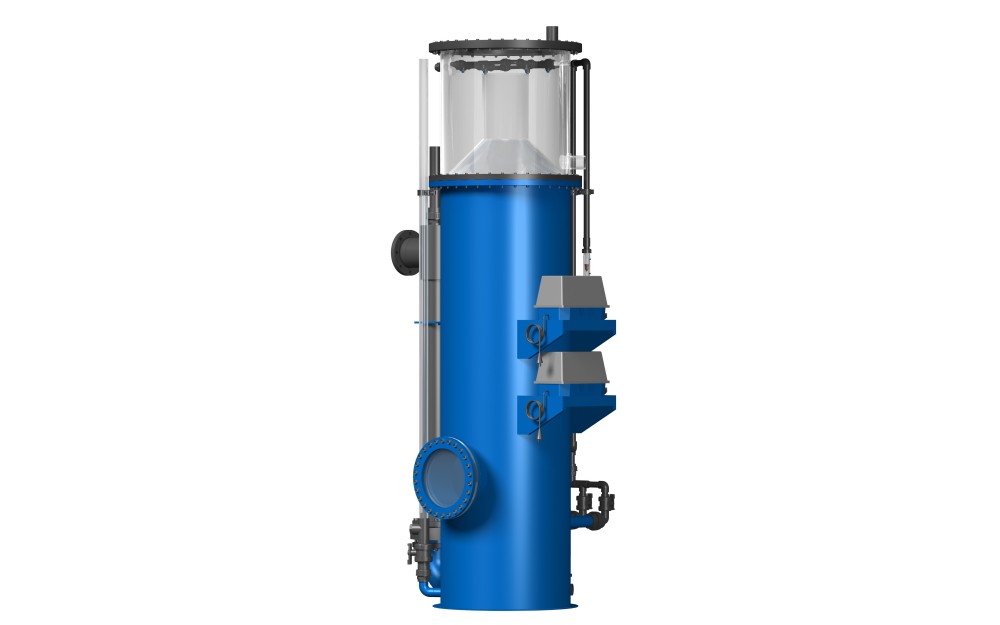
Protein skimming, or foam fractionation, is a separation process based on the concentration of waterborne compounds at the air/water interface. Widely used in marine aquariums, it also has applications in hatcheries, recirculating aquaculture systems (RAS), public aquariums and certain water treatment processes in aquaculture. Its benefits go far beyond the removal of “proteins”: it is an interfacial process whose performance depends on water composition, the available bubble surface area and the hydrodynamics of the contactor.
AQUACULTURE France is constantly pursuing innovation in this technology, which offers significant and technically distinctive advantages:
- Improved mechanical filtration
- Reduced load on the biofiltration system, removing almost one-third of the organic load
- Improved gas exchange, including CO₂ degassing and oxygenation
- The possibility of water sterilization through the addition of controlled ozonation
1. Why skim water in aquaculture or aquarium systems?
In an intensive system, feed is the main input of organic matter. Part of it is converted into biomass, another part is excreted in dissolved or particulate form, and a fraction is metabolized by microorganisms. Mechanical treatment primarily removes particles; the biofilter mainly transforms nitrogenous compounds; and degassing controls CO₂ in particular. The protein skimmer acts on another fraction: dissolved or colloidal organic matter with sufficient affinity for the air/water interface.
2. The physicochemical principle: creating a large air/water interface
An immersed air bubble forms an interface between a gas phase and an aqueous phase. Some dissolved molecules are amphiphilic: they contain hydrophilic groups and more hydrophobic portions. Their presence at the interface locally reduces interfacial energy and promotes their adsorption onto the surface of the bubbles.
As the bubbles rise, they therefore transport part of the adsorbed compounds toward the upper section of the contactor. The accumulation of a large number of bubbles produces a foam phase. This foam can be stabilized, concentrated and then discharged into a collection cup or recovery device.
3. Surface tension and interfacial energy
Surface tension γ characterizes the energy required to increase the area of an interface. It is expressed in N/m. In water, its value is relatively high compared with that of many organic liquids, due to the interactions between water molecules. Surfactants modify this interface and can consequently affect bubble size, stability and coalescence.
However, surface tension should not be considered in isolation. In a real protein skimmer, the composition of the interfacial film, local viscosity, biological surfactants, salinity, temperature and bubble-size distribution interact simultaneously.
4. Why are small bubbles advantageous?
For a spherical bubble with radius r, the surface area and volume are respectively:
S = 4πr² ; V = (4/3)πr³ ; S/V = 3/r
The surface-area-to-volume ratio therefore increases as the radius decreases. At a constant air volume, a population of small bubbles provides a much larger total interfacial area than a small number of large bubbles. This relationship explains the interest in microbubble generation.
However, this does not mean that the smallest possible bubble should always be sought: pressure losses, energy consumption, hydrodynamic stability, coalescence and foam quality impose an optimum.
5. Bubble formation, rise and coalescence
A bubble is not a static object. Its diameter may change as it rises, particularly through coalescence with other bubbles or through gas transfer between bubbles. Rising velocity depends on diameter, shape, viscosity and density of the medium. The presence of organic matter at the interface can slow coalescence and modify interfacial mobility.
In a protein skimmer, the objective is therefore not simply to produce bubbles: it is necessary to generate a sufficiently fine and stable bubble population, maintain good distribution throughout the contact column and promote the transport of adsorbed matter toward the collection zone.
6. Which compounds are actually removed?
The term “protein skimmer” is historically convenient but scientifically reductive. Potentially fractionated compounds include proteins, peptides, lipids associated with colloids, humic acids, pigments, certain microbial extracellular polymeric substances (EPS), and various organic molecules with an affinity for the interface. The fraction actually removed depends on its chemistry and its physical state in the water.
7. Organic carbon and organic matter: attention to definitions
Dissolved organic carbon (DOC) is not a homogeneous category from a skimming perspective. Two waters with the same total DOC concentration may behave very differently if their compounds have different interfacial properties. A hydrophilic, weakly surface-active fraction may be difficult to extract by skimming, whereas a colloidal fraction may be more readily concentrated.
Engineering note — AQUACULTURE France: An extraction rate should not be applied to the total DOC without characterizing the skimmable fraction. Mass balances should distinguish between total organic matter, the dissolved fraction and the fraction that can actually be fractionated.
8. Influence of salinity
Seawater and freshwater do not behave identically in a protein skimmer. Salinity modifies the properties of the medium and the stability of interfaces. Marine waters are more favorable to the formation of stable foam, which explains the widespread use of this technology in marine aquariology.
In freshwater, foam may be less stable. This does not mean that skimming is impossible: it can be effective when the organic load and skimmer design are suitable. The assessment of an engineering consultancy is essential, as it makes it possible to evaluate the relevance of the technology and the investment.
9. Contact time and hydrodynamics
Hydraulic residence time is an important parameter, but it is not sufficient to predict performance.
Some skimmer manufacturers claim exceptional performance because they consider high water and air flow rates to be guarantees of optimum efficiency. This approach is incorrect because it reduces the analysis to strictly mechanical criteria, essentially based on the electrical power ratings of the pumps they sell.
It is therefore necessary to consider not only the water flow rate and air flow rate, but also, and above all, the effective contact height, reactor cross-sectional area, bubble distribution, potential dead zones, internal recirculation, superficial velocity and the system’s ability to remove the generated foam.
10. Venturi injectors, diffusers and air-lift systems
Venturi systems use a local pressure drop created by water acceleration to draw in air. They can generate a very fine air/water mixture, but at the cost of pressure losses and pumping power that must be included in the overall energy balance.
Diffusers generate bubbles through nucleation at the pore openings. Their performance depends on the material, pore diameter, air flow rate, operating depth and surface condition. Air-lift systems use the density difference between water and the air/water mixture to generate circulation.
11. Protein skimming and ozone
The combination of ozone and protein skimming is particularly interesting in aquariology installations and marine aquaculture systems. Ozone can oxidize certain organic molecules and alter their behavior; at the same time, the skimmer can act as a gas/water contactor and contribute to the removal of some oxidized compounds or reaction products.
This combination requires careful control of ozone transfer, gas safety, ORP and, in seawater, brominated by-products.
Important note — Ozone should not be injected into a skimming system without assessing the risk of residual ozone release and without an appropriate degassing/destruction system. The design of the contactor and the gas treatment system must be considered as a single integrated system.
12. Protein skimming and MBBR biofiltration
The MBBR biofilter primarily transforms nitrogenous compounds and itself produces microbial organic matter, particularly in the form of biomass and EPS. A protein skimmer can reduce part of the organic precursors entering the biofilter and modify carbon availability for heterotrophic communities. It is therefore preferable not to operate the skimmer during the initial start-up phase of a biofilter.
In an RAS, each piece of equipment should not be considered in isolation. The removal of organic matter by skimming can modify biofilter performance, oxygen demand and sludge production dynamics.
On average, a properly sized skimmer can reduce the organic load on the biofiltration system by 25 to 50%.
13. Protein skimming and mechanical filtration
A protein skimmer is not a substitute for properly sized mechanical filtration. Large particles should be captured before they fragment and become solubilized. An effective strategy generally combines solids separation, dissolved/colloidal matter fractionation and biological treatment.
On average, a properly sized skimmer can reduce the load on mechanical filtration by 15 to 25%. The action of the skimmer is beneficial because its separation mechanism differs from that of a conventional particulate filter.
14. When does skimming become counterproductive?
Excessively aggressive skimming can remove compounds that are useful or necessary for the system, increase energy consumption and create operational instability. In reef aquariums, the pursuit of water that is extremely low in organic matter is not always desirable. In larval aquaculture, the situation depends even more strongly on the organisms being reared and their feeding regime.
Protein skimming is an interfacial separation process. Its efficiency relies on the ability of certain molecules to adsorb onto a population of bubbles and then become concentrated in a removable foam. Interfacial area, bubble-size distribution, interface stability, water composition and contactor hydrodynamics are inseparable factors.