



Hydraulic coupling and mass balances in RAS (1/2)
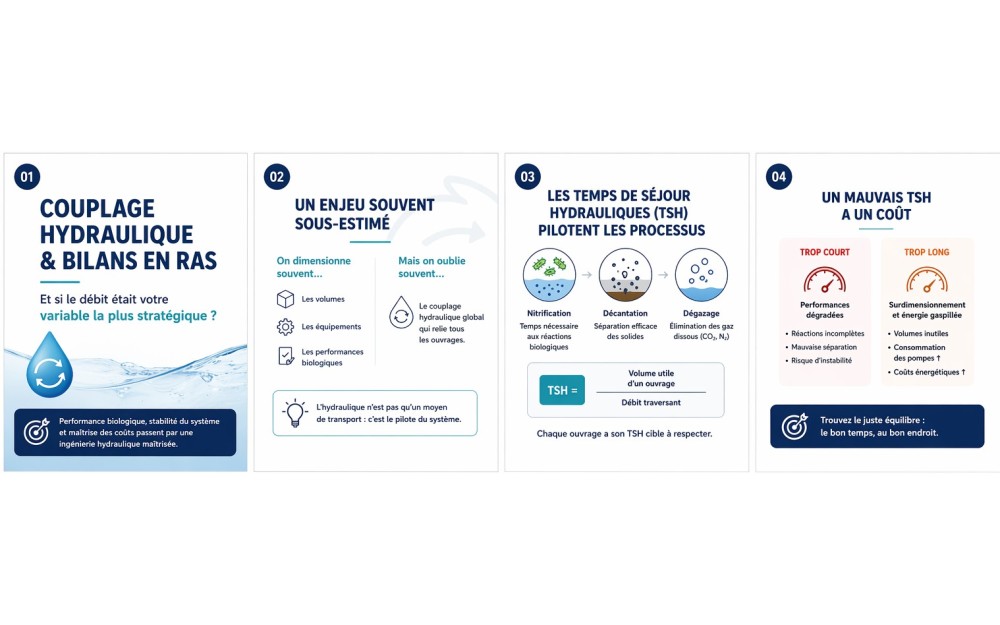
In a recirculating aquaculture system (RAS), hydraulics structure the overall operation of the process. Each treatment unit directly depends on the hydraulic retention time (HRT).
This parameter determines:
- The time available for biological reactions (e.g., nitrification)
- The efficiency of physical separation processes (sedimentation, filtration)
- Gas–liquid transfers (degassing, oxygenation)
Water flow ensures the coupling between system units:
tanks → filtration → biofiltration → degassing → disinfection
It simultaneously affects:
- Mass balances (input = output + accumulation)
- The management of nutrient and waste fluxes
- System stability
At steady state, inputs are considered equal to outputs (purge, assimilation, biological transformation).
The purge flow rate controls the accumulation of solids and nitrogen.
The right hydraulic–energy compromise can be summarized as follows:
- Increasing flow improves renewal and certain transfer processes, but significantly raises energy costs (pumping, head losses)
- Conversely, reducing flow lowers costs but degrades treatment performance
The challenge is therefore to design flow rates compatible with the target hydraulic retention times (HRT) of each process stage, without excessive energy consumption.
Hydraulic coupling and mass balances are inseparable. A high-performing RAS primarily relies on a finely tuned hydraulic balance.
In summary, in RAS, everyone talks about biofiltration, but many overlook a key point: hydraulics drives the system.
Flow is not only used to circulate water.
It determines:
- Hydraulic retention times
- Treatment performance
- Energy consumption
Poor hydraulic coupling leads to inefficient units, promotes accumulation (solids, nitrogen), and causes system instability.
Conversely, a well-balanced system stabilizes mass balances, optimizes each treatment stage, and limits energy costs.