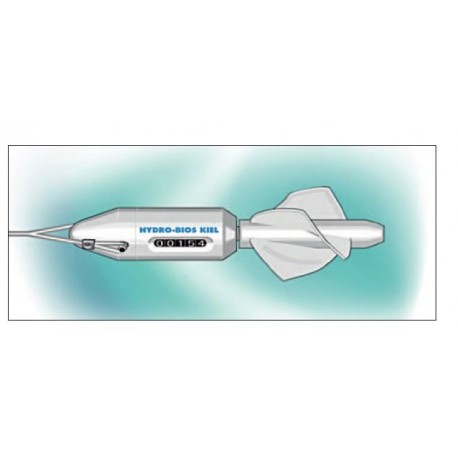



A mechanical STM current meter is an instrument used to measure water flow velocity in rivers, canals, drained ponds, or hydraulic structures. It belongs to the family of propeller-type flowmeters, which measure flow based on the rotation of a rotor driven by the current.
A mechanical STM current meter is an instrument used to measure water flow velocity in rivers, canals, drained ponds, or hydraulic structures. It belongs to the family of propeller-type flowmeters, which measure flow based on the rotation of a rotor driven by the current.
Mechanical instrument for measuring velocity and flow, for example through a plankton net or a concrete channel.
| Reference | Typ | Size(mm) | Weight(kg) |
| P0586100 | STM-mechanical | Ø75-180 | 0.3 |
Propeller (rotor)
Helical shape, made of metal or composite material. Its rotation speed is proportional to the water velocity.
High-precision shaft and bearing
Minimize friction to ensure accurate measurements even at low velocities.
Current meter body (rod / support)
Allows immersion at a precise depth. Can be mounted on a graduated rod or suspension cable.
Rotation sensor / pulse generator
Each full turn produces an electrical pulse (reed switch, induction, or embedded magnet), counted by:
an electromechanical counter,
a portable logger,
or an STM measurement unit.
STM calibration table
Provides the pulse ↔ velocity relation to obtain the accurate water velocity (m/s).
The current meter is placed in the flow, usually horizontally.
The current drives the propeller’s rotation.
The STM system converts the number of rotations into instantaneous velocity (m/s) using the calibration curve.
Multiplying average velocity by the wet cross-section gives the discharge.
Velocity range: ~0.03 to 5 m/s
Accuracy: ±1–2 %
Robustness: suitable for field measurements
Passive operation: no complex electronics, highly reliable
Velocity measurement for river discharge calculations
Hydrodynamic monitoring of ponds and drained reservoirs
Flow studies in aquaculture systems
Monitoring of pumping, drainage, and irrigation flows