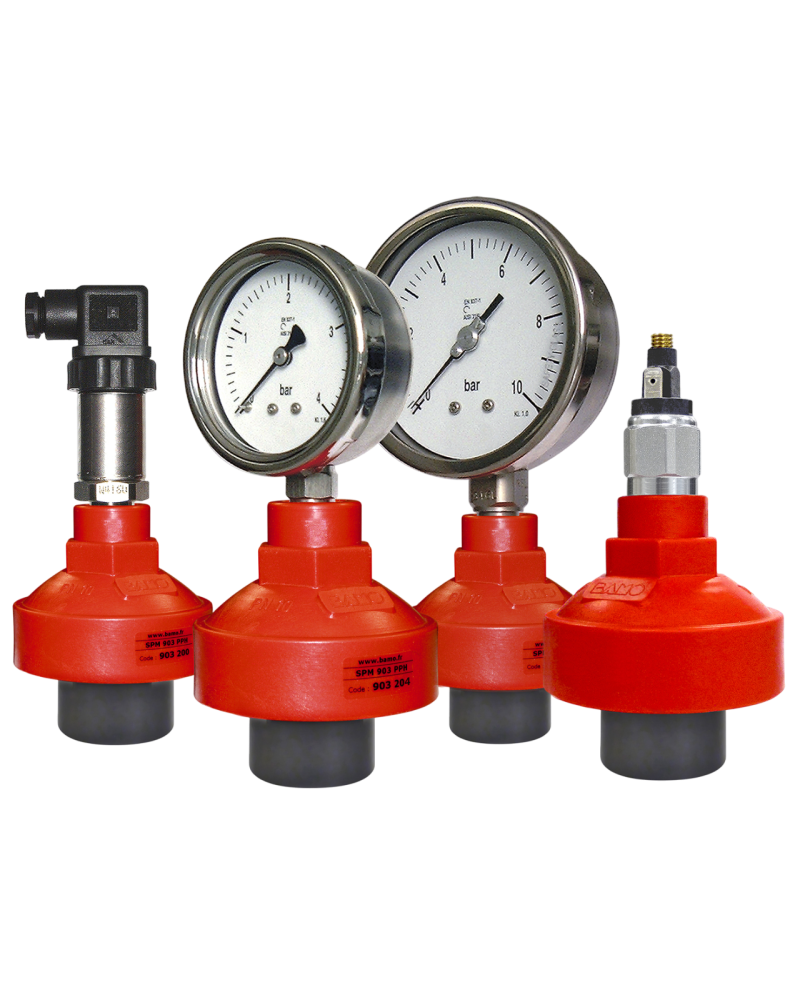

A food-grade separator (diaphragm isolator) protects the pressure sensor from aggressive, viscous, or particle-laden fluids while ensuring continuous and accurate pressure measurement.
The process fluid never contacts the sensor directly: it acts on a diaphragm, which transmits the pressure via a food-safe transmission fluid to the sensor.
A food-grade separator (diaphragm isolator) protects the pressure sensor from aggressive, viscous, or particle-laden fluids while ensuring continuous and accurate pressure measurement.
The process fluid never contacts the sensor directly: it acts on a diaphragm, which transmits the pressure via a food-safe transmission fluid to the sensor.
Separation diaphragm:
Made of inert, food-compliant materials (stainless steel AISI 316L, PTFE, Hastelloy…).
Isolates the process fluid from the sensor, preventing contamination.
Transmission chamber:
Filled with neutral, hygienic transmission fluid.
Transmits the diaphragm pressure linearly and reliably to the sensor.
Pressure sensor:
Can be stainless steel, ceramic, or other suitable materials.
Converts the transmitted pressure into an electrical signal for continuous monitoring.
Hygienic and food-compliant (FDA, EHEDG).
Protects the sensor from corrosion, clogging, and abrasive fluids.
Enables continuous pressure measurement in challenging processes.
Compatible with CIP/SIP (cleaning and sterilization in place).
Suitable for viscous, pasty, or particle-laden fluids.
Slightly more complex than a direct sensor → higher cost.
Requires regular maintenance of the transmission fluid to ensure accuracy.
Food industry: sauces, purees, milk, juice, beer, dairy products.
Pharmaceutical: gels, syrups, sterile suspensions.
Biotechnology and fine chemicals: sensitive or abrasive fluids.
Aquaculture: continuous pressure monitoring in circuits with particles or organic matter.