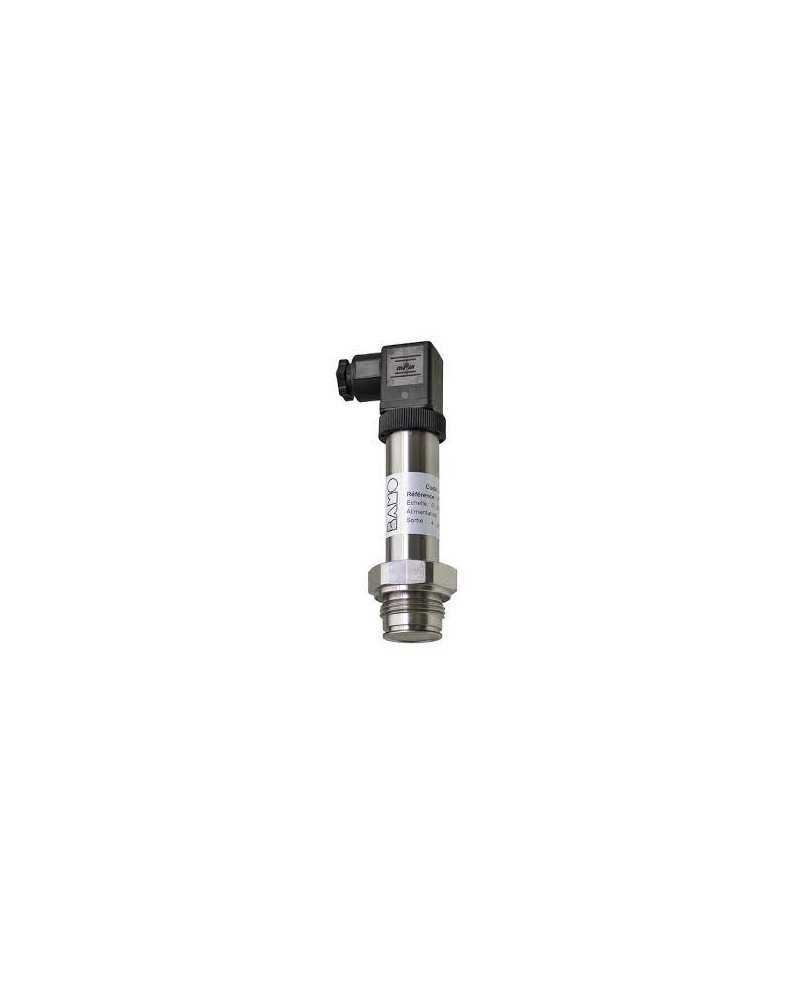


The ceramic membrane deforms when subjected to pressure (liquid or gas).
This deformation is measured by a piezoresistive (or capacitive) layer deposited on the membrane.
The change in resistance or capacitance is converted into an electrical signal proportional to the applied pressure.
The ceramic membrane deforms when subjected to pressure (liquid or gas).
This deformation is measured by a piezoresistive (or capacitive) layer deposited on the membrane.
The change in resistance or capacitance is converted into an electrical signal proportional to the applied pressure.
Ceramic membrane (usually alumina):
Very rigid and chemically inert.
Thickness adjusted according to the pressure range (typically 0–600 bar).
Sensitive layers:
Piezoresistive: Wheatstone bridge printed on the membrane.
Capacitive: variation of capacitance between membrane and substrate.
Housing / body:
Protects the sensing element and provides mechanical mounting.
Electrical output (wires, connector).
High mechanical strength (less risk of rupture compared to metallic membranes).
Chemical stability: resistant to corrosion, solvents, aggressive media.
High accuracy and low drift.
Low sensitivity to thermal shocks and temporary overpressure.
Easy to clean → suitable for food, pharmaceutical and water applications.
Less flexible than metallic membranes → smaller deformation, requiring more sensitive electronics.
Can be fragile under direct mechanical shocks.
Water industry (pumps, tanks, treatment plants).
Food industry (level measurement through hydrostatic pressure).
Pharmaceutical and medical fields.
Chemical processes.