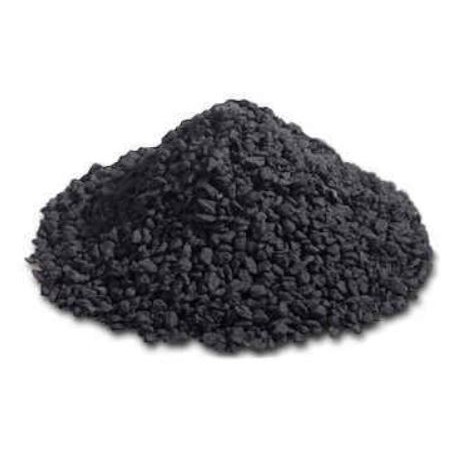



General Description:
Activated carbon is a porous material with a very high specific surface area, produced by the carbonization and activation (thermal or chemical) of organic materials such as wood, coconut shells, or peat.
In aquaculture and aquarium systems, it is used as a filter media to remove dissolved organic compounds, colorants, odors, and chemical residues from the water.
General Description:
Activated carbon is a porous material with a very high specific surface area, produced by the carbonization and activation (thermal or chemical) of organic materials such as wood, coconut shells, or peat.
In aquaculture and aquarium systems, it is used as a filter media to remove dissolved organic compounds, colorants, odors, and chemical residues from the water.
Appearance: black porous granules (granular activated carbon, GAC)
Particle size: typically 0.6–2.5 mm depending on filter type
Specific surface area: 800–1200 m²/g
Bulk density: 0.45–0.55 g/cm³
pH: neutral to slightly basic
Raw materials: wood, coconut shell, or mineral carbon
Adsorption of dissolved organic compounds (DOC/COD): removes humic acids, tannins, and color substances.
Elimination of chemical residues: chlorine, ozone, medications, antibiotics, or trace metals.
Water clarification: improves transparency and reduces odors.
Protection of biological filtration: decreases organic load before the biofilter.
Carbon filters in recirculating aquaculture systems (RAS).
Post-treatment after disinfection (ozone, chlorine).
Aquarium, ornamental pond, and quarantine tank filtration.
Treatment of make-up water before pond introduction.