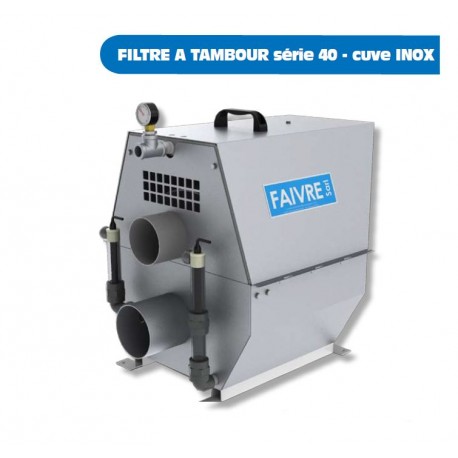


The Faivre Series 40 filter is a compact drum filter mounted in a stainless steel tank.
The liquid to be filtered enters the rotating drum, which is covered with a fine stainless-steel mesh.
Particles larger than the mesh size are retained on the outside of the filtering surface.
The drum rotates slowly (around 17 rpm depending on the model) and carries impurities towards a cleaning ramp.
A backwash ramp with nozzles cleans the filter plates, removing impurities into a sludge channel.
The cleaned water passes through the mesh and is discharged to the filtered outlet.
The Faivre Series 40 filter is a compact drum filter mounted in a stainless steel tank.
The liquid to be filtered enters the rotating drum, which is covered with a fine stainless-steel mesh.
Particles larger than the mesh size are retained on the outside of the filtering surface.
The drum rotates slowly (around 17 rpm depending on the model) and carries impurities towards a cleaning ramp.
A backwash ramp with nozzles cleans the filter plates, removing impurities into a sludge channel.
The cleaned water passes through the mesh and is discharged to the filtered outlet.
Filter 40 on Stainless Steel Tank
With a 40 cm drum diameter, reduced size and weight, this very compact filter can be installed quickly even in confined spaces.
General features:
Flow rate up to 21 m³/h at 100 microns
Stainless steel filtration from 26 to 500 microns
Filter construction on frame in stainless steel AISI 304L, 316L and Duplex stainless steel
Filter construction on tank in stainless steel AISI 304L, 316L
High-quality machine with simple and robust design
| Model | Meshsize (µm) |
| 1 | 26 |
| 2 | 36 |
| 3 | 43 |
| 4 | 63 |
| 5 | 80 |
| 6 | 100 |
| 7 | + |
Max. flow rate: up to approx. 43 m³/h at 100 µm
Filter mesh: from 15 to 500 µm depending on version
Drum diameter: 40 cm
Stainless steel construction: Tank in AISI 304L or 316L (Duplex / Super Duplex optional for higher resistance)
Drive system: “Direct Drive” — drum directly coupled to the gear motor
Rinsing nozzles: typically 3, with optimized pressure to avoid damaging the mesh
Rinsing ramp: equipped with a pressure gauge connection for backwash monitoring
Removable cover: for maintenance access
Options: level sensor, timer, optional rinse pump, electrical control panel with safety shutdowns
Compact size: easy to install in restricted spaces
Robust stainless steel construction: corrosion resistance, long service life
Adjustable mesh size: adaptable to system requirements
Automatic backwash: reduces manual maintenance and water loss
With excessive particle load (suspended solids), clogging may occur more often, requiring frequent rinsing
For very high turbidity or extremely fine particles (smaller than minimum mesh), efficiency decreases
Rinsing system must be properly dimensioned (pressure, flow) for efficient cleaning without mesh damage
Stainless steel type (304L vs 316L vs Duplex) must match the water type (fresh, brackish, chemical) to avoid corrosion
In case of power failure or motor breakdown, the filter may stop functioning, causing clogging risk

You might also like