

ANOXKALDNES™ MBBR media is recognized worldwide as one of the most reliable biological filtration solutions for Recirculating Aquaculture Systems (RAS). Based on the Moving Bed Biofilm Reactor (MBBR) technology, it provides an ideal environment for the growth of nitrifying bacteria responsible for ammonia and nitrite removal.
The floating polyethylene carriers move continuously inside the reactor, driven by aeration or water circulation. This constant movement optimizes oxygen transfer, prevents clogging, and maintains highly efficient biological treatment.
ANOXKALDNES™ MBBR media is recognized worldwide as one of the most reliable biological filtration solutions for Recirculating Aquaculture Systems (RAS). Based on the Moving Bed Biofilm Reactor (MBBR) technology, it provides an ideal environment for the growth of nitrifying bacteria responsible for ammonia and nitrite removal.
The floating polyethylene carriers move continuously inside the reactor, driven by aeration or water circulation. This constant movement optimizes oxygen transfer, prevents clogging, and maintains highly efficient biological treatment.
Since the mid-1990s, Moving Bed Bioreactor (MBBR™) biological filtration technology has become more than just a standard in aquaculture. Compared with other treatment methods, MBBR™ technology offers significant advantages, including high efficiency, a compact footprint, and ease of operation.
In MBBR™ technology, a biofilm develops on the protected surface of specially designed carriers featuring a large internal surface area.
These bio-carriers are distributed throughout the water volume and remain in continuous motion within a tank or reactor of defined volume. An aeration grid located at the bottom of the filter supplies oxygen to the biofilm while providing the energy required to mix and keep the carriers in suspension.
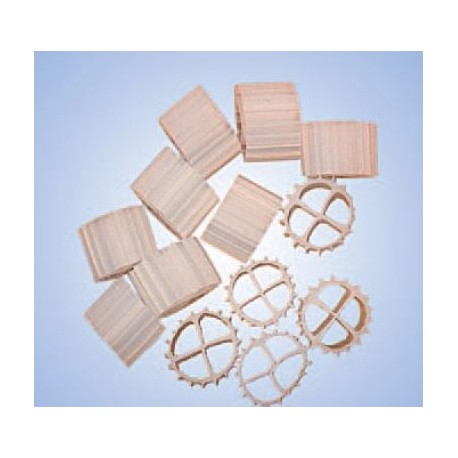
Specialized carriers have been developed for different applications. Among them, the most widely used in aquaculture is the K3 media, manufactured exclusively by ANOXKALDNES for MBBR™ technology.
| Models | Reference | Name | m2 / m3 (*) | m2 / m3 (**) | Ø/longueur (mm) | density. 9 | Poids (kg/m3) |
| 1 | G0412100 | AnoxKaldnes K1-0.95 RBMM | 800 | 500 | 9/7 | 0.95 | 145 |
| 2 | G0412200 | AnoxKaldnes K3-0.98 DENI | 600 | 500 | 9/7 | 0.98 | 150 |
| 3 | G0412300 | AnoxKaldnes K3 | 600 | 500 | 25/12 | 0.95 | 95 |
|
(*) Superficie Total (**) Superficie protegida |
|||||||
AQUACULTURE FRANCE offers a complete range of biological filter media specifically designed for aquaculture, fish farming, shellfish farming, public aquariums, and ornamental ponds.
Our biological media are completely inert and perfectly suited for the growth of nitrifying bacteria in both freshwater and seawater applications.
Biological filtration is highly effective in oxidizing ammonia and nitrite present in culture water.
The sizing of a biological filtration system depends on several parameters, including fish biomass, aquarium or pond volume, feeding rate, and water temperature. Based on these criteria, we can determine the required media volume and hydraulic flow rate.
Nitrifying bacteria colonize the protected surface area of the media:
The continuous movement of the media promotes:

You might also like