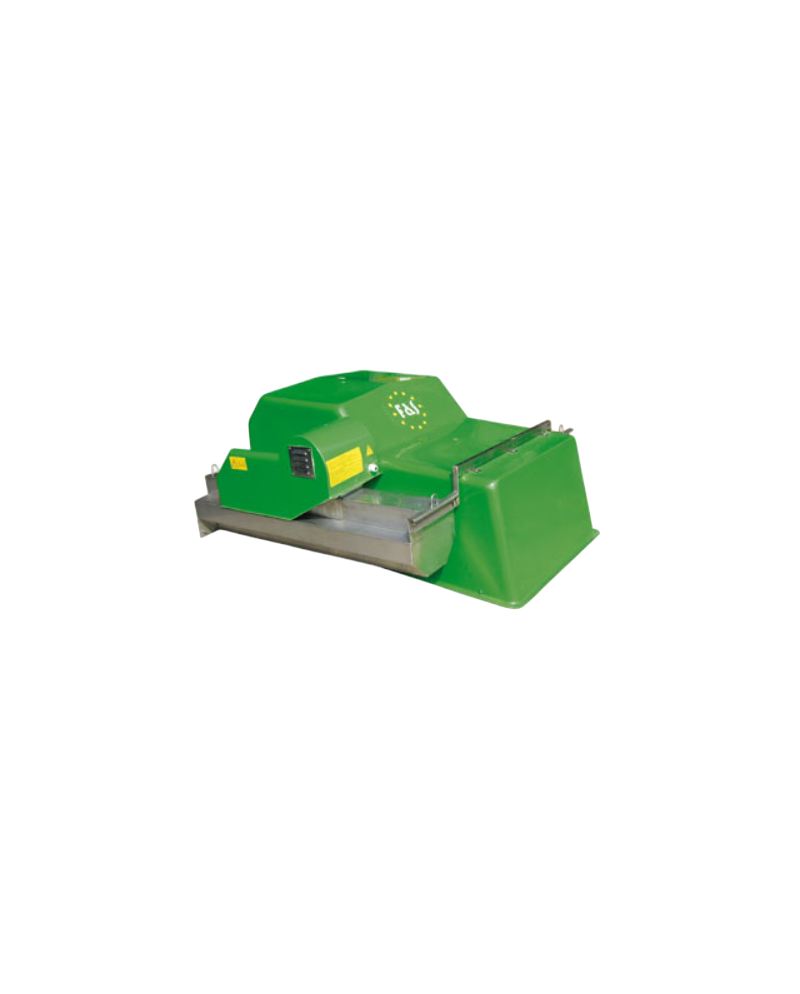



A FAS floating oxygenator is a turboxygen device used in aquaculture. It works with an immersed paddle drum that stirs the water and increases contact with air, which:
adds dissolved oxygen,
removes gases (CO₂, nitrogen),
improves water circulation.
It is floating, durable, and low-maintenance, built with fiberglass-reinforced polyester and stainless steel, powered by three-phase electricity.
Models provide from 0.3 up to nearly 2 kg O₂/h depending on power.
Suitable for fish ponds and tanks to ensure survival and growth during critical periods (heat, high biomass, feeding).
A FAS floating oxygenator is a turboxygen device used in aquaculture. It works with an immersed paddle drum that stirs the water and increases contact with air, which:
adds dissolved oxygen,
removes gases (CO₂, nitrogen),
improves water circulation.
It is floating, durable, and low-maintenance, built with fiberglass-reinforced polyester and stainless steel, powered by three-phase electricity.
Models provide from 0.3 up to nearly 2 kg O₂/h depending on power.
Suitable for fish ponds and tanks to ensure survival and growth during critical periods (heat, high biomass, feeding).
The FAS oxygenators enable oxygen enrichment in open tank systems and provide additional degassing in recirculating systems. The units do not require a protective screen and are highly efficient and resistant to clogging. An integrated mechanism ensures stable positioning in the water.
Materials: FRP (FRP = fibre-reinforced polyester) and stainless steel, AISI 304L (AISI 316 available as an option for seawater applications).
| Models |
1 |
2 | 3 | 4 |
| FAS |
KR95 |
KR94 | KR94L | LR200 |
| Reference | E1122500 | E1122600 | E1122700 | E1122800 |
| O2- Apport | 500 g/h | 1.000 g/h | 2.000 g/h | 2.700 g/h |
| Kg O2/h (70%) | 350 g/h (*) | 700 g/h (*) | 1400 g/h (*) | 1900 g/h (*) |
| Power | 400V/50Hz~3 | 400V/50Hz~3 | 400V/50Hz~3 | 400V/50Hz~3 |
| Motor |
0.18 kW | 0.25 kW | 0.37 kW | 0.75 kW |
| Lenght-Width-Height (mm) |
1100-700-600 | 1650-1000-800 | 1650-1450-800 | 1730-1770-800 |
| Weight (kg) | 37 | 55 | 65 | 90 |
| (*) Empirical value at 70% efficiency | ||||
| (**) Other voltages available on request | ||||
The FAS floating oxygenator is a turbo-oxygenation device: a paddle drum rotates inside a sealed housing, splitting the water flow and increasing contact with oxygen. This improves dissolved oxygen levels and also contributes to degassing (CO₂, N₂) in recirculating systems.
Suitable for fish farming ponds and tanks, RAS support systems, and for preventing oxygen depletion during critical periods such as high temperatures, feeding peaks or high biomass conditions.
Floating and stable, with no protective screen required, the unit offers excellent resistance to clogging. The structure is made of FRP (fibre-reinforced polyester) and AISI 304L stainless steel (AISI 316 available as an option for seawater applications).
Available in three-phase 400 V / 50 Hz versions (other voltages available on request).
Few exposed components; periodic inspection of the drum/paddles and floats, rinsing, and checking of the power cable are recommended.
You might also like