
A pressurized CO₂ kit for an aquarium (with cylinder + regulator) generally consists of the following elements:
Main components
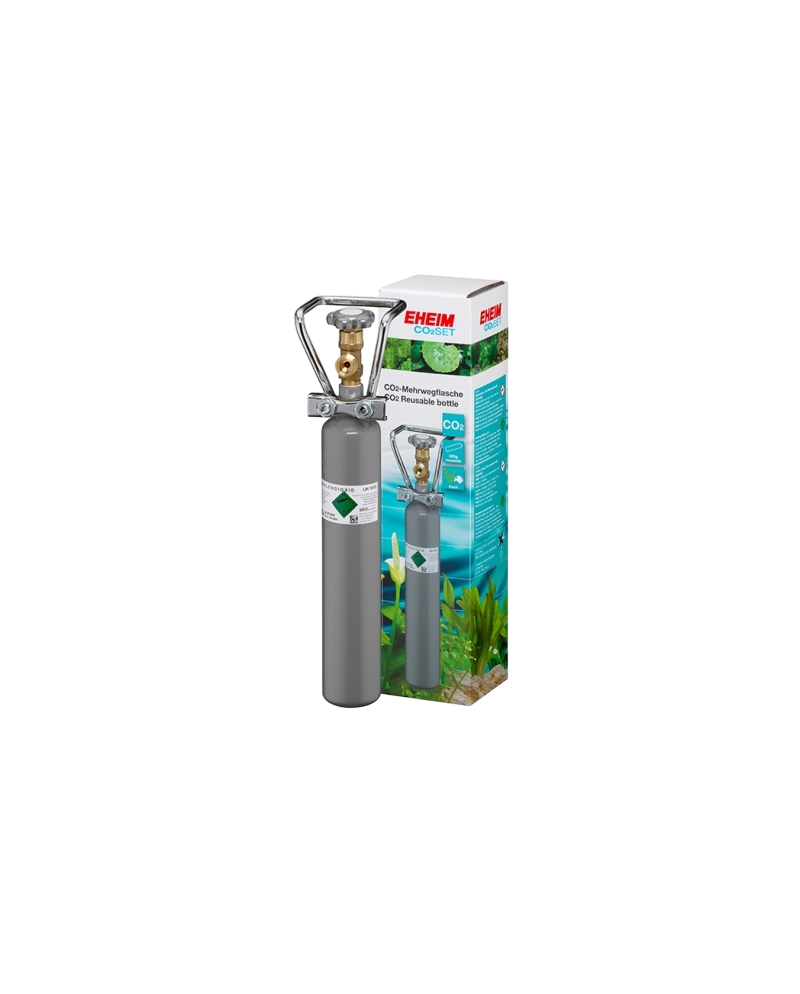
CO₂ Cylinder
This is the CO₂ “reserve”, usually made of steel or aluminum, under high pressure (often around 50–70 bar depending on temperature).
It can be “disposable” (single-use) or refillable. Some kits use certified refillable cylinders.
You must check the thread type / connector of the cylinder to ensure compatibility with the regulator.
Regulator
Used to reduce the high pressure of the cylinder to a lower “working pressure” suitable for the aquarium (for example around 1.5 bar for some regulators).
Often equipped with two pressure gauges: one shows the pressure in the cylinder, the other the output pressure (working pressure).
An adjustment screw (needle valve) allows precise control of the CO₂ flow (bubble count).
CO₂ Tubing
Connects the regulator to the diffuser (or another dissolution system) in the aquarium.
Bubble Counter
Allows visual monitoring of the CO₂ “flow”: you count the number of bubbles per second/minute to set the dosage.
Very useful for fine-tuning and calibrating the injection.
CO₂ Diffuser (or atomizer)
Placed inside the aquarium: it turns the CO₂ into micro-bubbles so it dissolves into the water.
Several types exist: ceramic, glass, reactor, U-tube… depending on tank size and desired diffusion efficiency.
A pressurized CO₂ kit for an aquarium (with cylinder + regulator) generally consists of the following elements:
Main components
CO₂ Cylinder
This is the CO₂ “reserve”, usually made of steel or aluminum, under high pressure (often around 50–70 bar depending on temperature).
It can be “disposable” (single-use) or refillable. Some kits use certified refillable cylinders.
You must check the thread type / connector of the cylinder to ensure compatibility with the regulator.
Regulator
Used to reduce the high pressure of the cylinder to a lower “working pressure” suitable for the aquarium (for example around 1.5 bar for some regulators).
Often equipped with two pressure gauges: one shows the pressure in the cylinder, the other the output pressure (working pressure).
An adjustment screw (needle valve) allows precise control of the CO₂ flow (bubble count).
CO₂ Tubing
Connects the regulator to the diffuser (or another dissolution system) in the aquarium.
Bubble Counter
Allows visual monitoring of the CO₂ “flow”: you count the number of bubbles per second/minute to set the dosage.
Very useful for fine-tuning and calibrating the injection.
CO₂ Diffuser (or atomizer)
Placed inside the aquarium: it turns the CO₂ into micro-bubbles so it dissolves into the water.
Several types exist: ceramic, glass, reactor, U-tube… depending on tank size and desired diffusion efficiency.
Operation
The regulator is attached to the cylinder (with the appropriate connector).
The cylinder is opened, and the high pressure is then “reduced” by the regulator to a lower working pressure.
The output pressure is adjusted using the regulator’s adjustment screw.
Using the fine valve / needle valve, the flow rate is set (number of bubbles in the bubble counter).
The tubing carries the CO₂ to the diffuser, which injects it into the aquarium.