
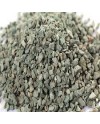

Zeolite is a natural or synthetic microporous mineral used in aquaculture biofiltration to improve water quality in ponds, tanks, and recirculating aquaculture systems (RAS). Thanks to its crystalline, honeycomb-like structure, it provides:
a high ion exchange capacity, useful for retaining ammonium (NH₄⁺),
and a large surface area for the growth of nitrifying bacteria, essential for breaking down nitrogenous waste.
Zeolite is a natural or synthetic microporous mineral used in aquaculture biofiltration to improve water quality in ponds, tanks, and recirculating aquaculture systems (RAS). Thanks to its crystalline, honeycomb-like structure, it provides:
a high ion exchange capacity, useful for retaining ammonium (NH₄⁺),
and a large surface area for the growth of nitrifying bacteria, essential for breaking down nitrogenous waste.
Composition: aluminum-silicate with sodium/potassium (varies by type).
Form: granules or beads, typically 1–5 mm in diameter.
Density: ~0.7–1.2 g/cm³.
Surface area: 50–800 m²/g depending on type and granularity.
Stable pH and chemically inert in water.
Durability: long-lasting, resistant to crushing and abrasion.
Removal of ammonium and ammonia (NH₄⁺ / NH₃)
Zeolite exchanges ammonium ions with sodium or potassium ions, reducing toxicity for fish.
Biological support for nitrifying bacteria
Nitrifiers (Nitrosomonas and Nitrobacter) attach to the porous surface, converting ammonium into nitrites and then nitrates (nitrification process).
Water stabilization
Reduces nitrogen peaks, improves water quality, and decreases odor.
High ammonium retention capacity.
Ideal support for biofiltration due to its large surface area.
Non-toxic and chemically stable, does not alter water pH.
Reusable after rinsing or regeneration.
Can become saturated quickly with NH₄⁺ if flow or nitrogen load is high.
Requires periodic replacement or regeneration.
Less effective for other organic pollutants (needs combination with mechanical or biological filters).
Filtration of freshwater or marine fish tanks (tilapia, trout, carp, salmon).
RAS (Recirculating Aquaculture Systems).
Pre-treatment of effluents to reduce ammoniacal nitrogen before discharge or water reuse.
Combined with fluidized bed biofilters or drum filters for complete treatment