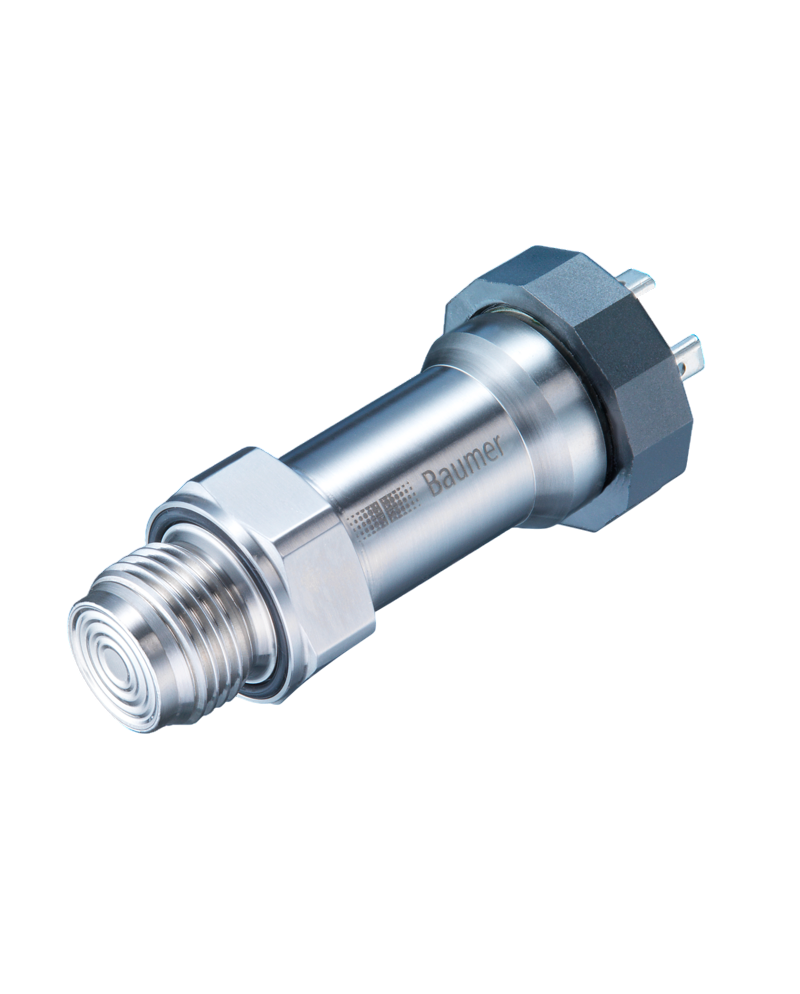

The sensing membrane is positioned flush with the sensor surface (no recessed cavity).
When the fluid applies pressure, the membrane deforms.
This deformation is converted into an electrical signal through piezoresistive, capacitive, or piezoelectric technology, depending on the model.
The sensing membrane is positioned flush with the sensor surface (no recessed cavity).
When the fluid applies pressure, the membrane deforms.
This deformation is converted into an electrical signal through piezoresistive, capacitive, or piezoelectric technology, depending on the model.
Flush membrane (often stainless steel, titanium, or ceramic):
Directly in contact with the fluid.
Smooth surface to prevent deposits.
Measuring element:
Converts the deformation of the membrane into an electrical signal proportional to the pressure.
Housing and connection:
Designed for easy integration into pipes or tanks.
Electrical output (cable or connector).
Ideal for viscous fluids, pastes, or particle-loaded media (prevents clogging).
Easy to clean (compatible with CIP/SIP cleaning processes).
Hygienic surface → suitable for food and pharmaceutical industries.
Accurate measurement even with sticky or abrasive fluids.
Can be more expensive than standard sensors.
The exposed membrane may be sensitive to abrasion or mechanical shocks.
Food industry: viscous products (purees, yogurts, sauces).
Pharmaceutical industry: sterile fluids, gels, viscous solutions.
Chemical industry: slurries, adhesives, resins.
Aquaculture: monitoring water pressure and level in ponds or circuits containing suspended matter.