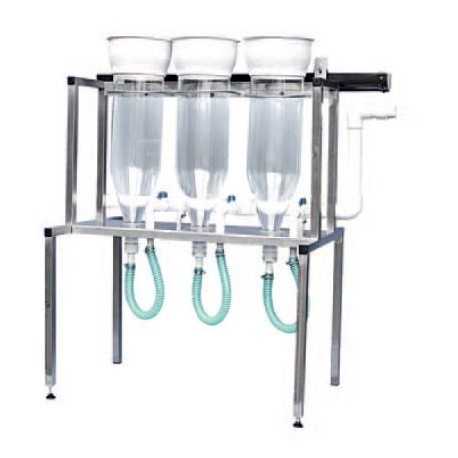



An incubation system with Zug bottles in rack is a device widely used in fish farming for the artificial incubation of fish eggs (carp, tilapia, catfish, salmonids, etc.).
Rack support
Metal or PVC frame used to hold several bottles in parallel.
Usually inclined to facilitate water circulation.
Zug bottles
Glass or transparent plastic flasks, shaped like an inverted bottle.
The narrow neck at the bottom allows water flow, while the wider part holds the eggs.
Capacity ranges from 0.5 to 3 liters.
Water supply
Water enters at the top of the rack and is distributed to each bottle.
Flow is adjustable with valves or pipettes.
The water must be clean, oxygenated, and temperature-controlled.
Water outlet
Water flows upward through the eggs, creating a gentle upward movement that keeps them in suspension without damage.
Water exits through an overflow or outlet tube.
An incubation system with Zug bottles in rack is a device widely used in fish farming for the artificial incubation of fish eggs (carp, tilapia, catfish, salmonids, etc.).
Rack support
Metal or PVC frame used to hold several bottles in parallel.
Usually inclined to facilitate water circulation.
Zug bottles
Glass or transparent plastic flasks, shaped like an inverted bottle.
The narrow neck at the bottom allows water flow, while the wider part holds the eggs.
Capacity ranges from 0.5 to 3 liters.
Water supply
Water enters at the top of the rack and is distributed to each bottle.
Flow is adjustable with valves or pipettes.
The water must be clean, oxygenated, and temperature-controlled.
Water outlet
Water flows upward through the eggs, creating a gentle upward movement that keeps them in suspension without damage.
Water exits through an overflow or outlet tube.
Customized systems ready to use, complete with stainless steel frame, drainage gutter, and piping.
| Models | Reference | Info. | Capacity | Waterflowrate | Lenght - Width - Height (mm) | Weight(kg) |
| 1 | C0034500 | MC-III-SYSTEM - 3x | 120.000 | ~12 l/min. | 1050 - 510 - 1450 | 20 |
| 2 | C0034510 | MC-III-SYSTEM - 4x | 160.000 | ~16 l/min. | 1250 - 510 - 1450 | 24 |
| 3 | C0034520 | MC-III-SYSTEM - 6x | 240.000 | ~ 24 l/min. | 1650 - 510 - 1450 | 31 |
| 4 | C0034530 | MC-III-SYSTEM - 8x | 320.000 | ~ 32 l/min. | 2050 - 510 - 1450 | 39 |
| 5 | C0034540 | MC-III-SYSTEM - 10x | 400.000 | ~ 40 l/min. | 1450 - 1000 - 1450 | 33 |
| 6 | C0034550 | MC-III-SYSTEM - 12x | 480.000 | ~ 48 l/min. | 1650 - 1000 - 1450 | 37 |
| 7 | C0034560 | MC-III-SYSTEM - 16x | 640.000 | ~ 64 l/min. | 2050 - 1000 - 1450 | 46 |
| Autres dimensions et versions sur demande | ||||||
Fertilized eggs are placed in the wider part of the bottle.
Water flows from bottom to top, ensuring:
Constant oxygenation of the eggs.
Removal of metabolic waste and dead shells.
Gentle agitation preventing eggs from sticking together.
Once hatched, larvae are carried out with the water current and can be collected in a downstream tank.
High incubation density in limited space (several bottles per rack).
High survival rate thanks to optimal oxygenation.
Easy monitoring and handling (each bottle is independent).
Reduced water consumption compared to traditional incubators.