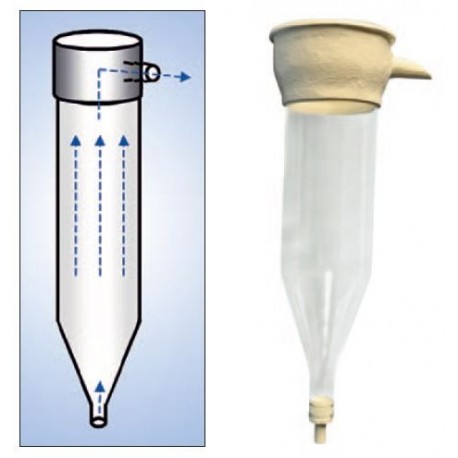


The Zug Jar is a vertical incubator specifically designed for fish egg incubation in hatcheries and aquaculture facilities. Its operating principle is based on an upward water flow that keeps the eggs in gentle suspension, ensuring optimal oxygen supply while reducing sediment accumulation, clogging, and fungal growth.
Manufactured from transparent materials, the Zug Jar allows continuous visual monitoring of egg development. It is widely used for salmonids, whitefish, sturgeon, cyprinids, and many other freshwater and marine species.
The Zug Jar is a vertical incubator specifically designed for fish egg incubation in hatcheries and aquaculture facilities. Its operating principle is based on an upward water flow that keeps the eggs in gentle suspension, ensuring optimal oxygen supply while reducing sediment accumulation, clogging, and fungal growth.
Manufactured from transparent materials, the Zug Jar allows continuous visual monitoring of egg development. It is widely used for salmonids, whitefish, sturgeon, cyprinids, and many other freshwater and marine species.
Mouth-blown glass bottle with bottom water inlet and top section in GRP (glass-reinforced plastic). In aquaculture, it is often used for the incubation of trout, carp, or other fish species eggs. For the first feeding stage, the fry must be transferred to suitable tanks. Available as a bare bottle or as a complete, ready-to-use system.
| Models | Reference | Info. | Capacity | Water flowrate | Lenght- Width - Height (mm) | Weight (kg) |
| 1 | C0034000 | MC-III (8 Liter) | 40.000(*) |
~ 4 l/min. |
ø 160/450 |
1.5 |
| 2 | C0034100 | MC-III avec entrée de d20 mm et partie supérieure |
ø 225/754 |
1.8 | ||
| (*) Truite | ||||||
Main function:
The Zug bottle is used for fish egg incubation, particularly for cyprinids (carps, tench) and other species requiring continuous movement.
Operating principle:
The bottle is filled with water in constant motion, generated by an upward airflow.
Air bubbles create a rotating movement of the eggs, preventing clumping and ensuring optimal oxygenation.
This system mimics a naturally turbulent environment, suitable for incubating non-sticky eggs.
Features:
Cylindro-conical shape, usually in transparent plastic for easy monitoring.
Variable capacity depending on hatchery needs.
Easy to clean and monitor.
Applications:
Incubation of common carp, grass carp, silver carp, bighead carp.
Adaptable to other species that require constant egg movement.