


An incubation trough (or hatching trough) is a device used in aquaculture for incubating fish eggs, mainly those of species with non-adhesive eggs (e.g., salmonids, carp, catfish, etc.).
An incubation trough (or hatching trough) is a device used in aquaculture for incubating fish eggs, especially species with non-adhesive eggs (e.g., salmonids, carp, catfish).
It is an elongated tank or channel with a constant water flow, ensuring:
adequate oxygenation of the eggs,
removal of metabolic wastes and empty shells,
and stable physical and thermal conditions.
An incubation trough (or hatching trough) is a device used in aquaculture for incubating fish eggs, mainly those of species with non-adhesive eggs (e.g., salmonids, carp, catfish, etc.).
An incubation trough (or hatching trough) is a device used in aquaculture for incubating fish eggs, especially species with non-adhesive eggs (e.g., salmonids, carp, catfish).
It is an elongated tank or channel with a constant water flow, ensuring:
adequate oxygenation of the eggs,
removal of metabolic wastes and empty shells,
and stable physical and thermal conditions.
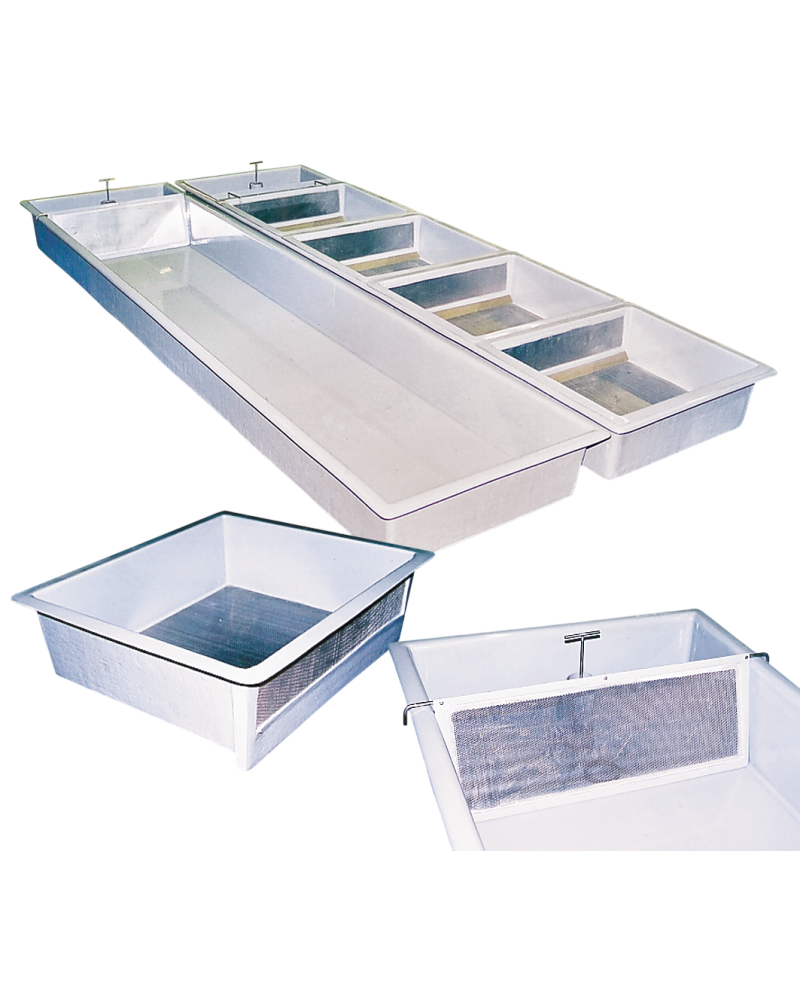
High-quality FRP incubation trough for the incubation and first feeding stage of salmonids, including perforated baskets with standard 2 mm holes, vertical and inclined screens, 50 mm overflow pipe with handle, and stainless steel fittings.
| Models | Reference | Number of clays | Capacity | Flowrate | Lenght - Width - Height | Weight (kg) |
| 1 | C0010100 | 2 | 20.000 / 14.000 (*) | 6-10l/min. | 1480 - 590 -190 | 16.0 |
| 2 | C0010200 | 4 | 40.000 / 28.000 (*) | 8-12 l/min. | 2330 - 590 - 190 | 28.0 |
| 3 | C0010300 | 7 | 70.000 / 49.000 (*) | 8-12 l/min. | 4000 - 590 - 190 | 53.0 |
| 4 | C0011100 | Bare hatching trough for 2 clay | 1480 - 590 - 180 | 8.5 | ||
| 5 | C0011200 | Bare hatching trough for 4 clay | 2330 - 590 - 180 | 13.0 | ||
| 6 | C0011300 | Bare hatching trough for 7 clay | 4000- 590 - 180 | 28.0 | ||
| 7 | C0012100 | Bare clay | 580 - 500 - 180 | 3.0 | ||
| (*) Trout/salmon | ||||||
Material: Usually made of PVC, fiberglass, stainless steel, or painted concrete, depending on durability and cost.
Typical dimensions:
Length: 1–3 m
Width: 20–40 cm
Depth: 15–30 cm
Slope: Slight (1–2%) to allow smooth water flow.
Covers: Often used to protect eggs from direct light and predators.
Water inlet at the head of the trough, regulated by a diffuser or small weir to distribute the flow evenly.
Water circulation throughout the length:
constant, moderate flow rate (0.2–1 L/s depending on species),
stable temperature (typically 10–15 °C for salmonids).
Water outlet at the downstream end, sometimes fitted with a screen to retain fry.
Incubation trays or screens support the eggs, sometimes arranged in multiple stacked troughs.
Eggs are disinfected (e.g., with iodophor) before incubation.
Daily monitoring is required:
removal of dead (white) eggs,
control of flow rate, temperature, and oxygen levels.
After hatching, larvae remain in the trough until the yolk sac is absorbed, then transferred to rearing tanks.
Excellent control of incubation conditions.
Space-efficient (stackable troughs).
Easy egg and fry handling.
Reduced loss from clogging or oxygen deficiency.
Sensitive to fluctuations in water quality and flow.
Requires frequent cleaning to prevent biofilm buildup.
Dependent on a constant, clean water supply.

You might also like