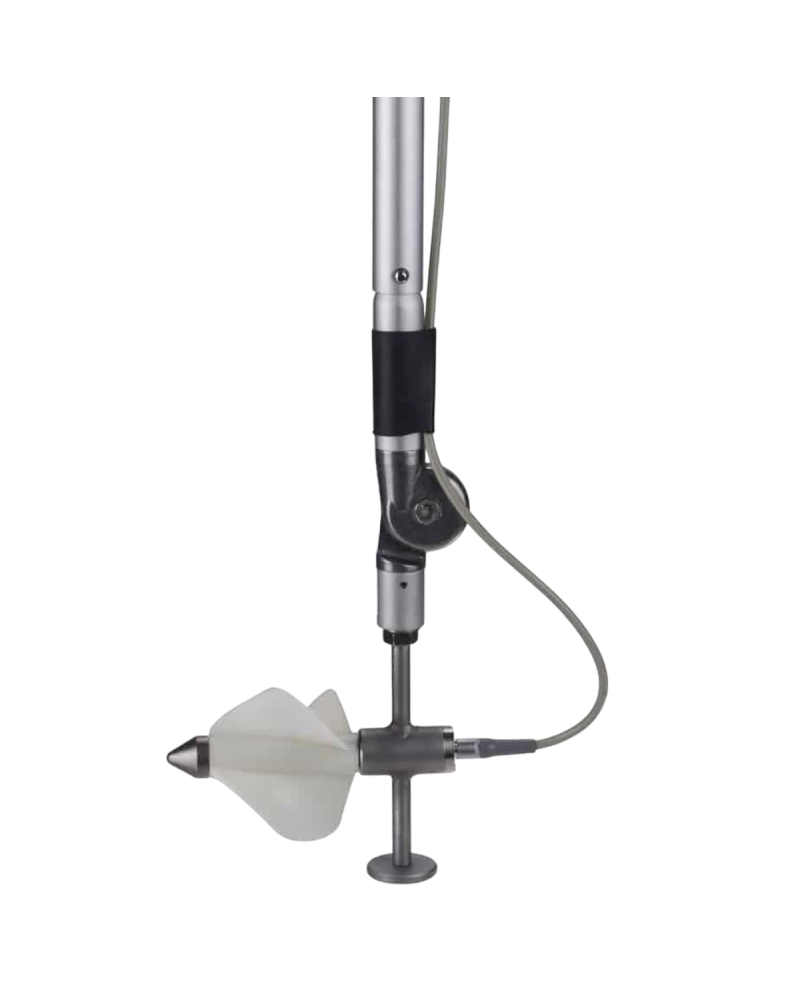



An RCHM current meter is a hydrometric instrument designed to measure water velocity and, consequently, flow rate in rivers, canals, hydraulic systems, or sampling devices such as nets or test channels.
It is a mechanical propeller-type current meter, both robust and precise, suitable for laboratory and field use.
An RCHM current meter is a hydrometric instrument designed to measure water velocity and, consequently, flow rate in rivers, canals, hydraulic systems, or sampling devices such as nets or test channels.
It is a mechanical propeller-type current meter, both robust and precise, suitable for laboratory and field use.
Propeller (rotor)
A lightweight, well-balanced propeller whose rotation speed is proportional to water velocity.
High-sensitivity shaft and bearings
Minimize friction to measure low velocities with high accuracy.
Current meter body
Designed to be mounted on a rod, cable, net frame, or immersion arm.
Pulse sensor
Each rotation generates a pulse (reed switch, magnet, or inductive sensor) recorded by a counter or datalogger.
RCHM calibration curve
Provides the relationship between the number of pulses and actual velocity (m/s), necessary for reliable hydraulic data.
The current meter is positioned steadily in the flow.
The moving water makes the propeller rotate.
Pulses are counted over a known time interval.
Velocity is computed using the calibration curve.
Flow rate can be calculated if the cross-section is known.
Accurate measurement from very low velocities (≈ 0.03 m/s) to higher speeds depending on the model
Robust construction for field or laboratory
Simple and reliable mechanical design, little affected by electrical noise
Compatible with plankton nets, concrete channels, pipes, and natural streams
Velocity measurement in rivers, ditches, canals
Flow characterization in plankton nets
Velocity measurement in concrete channels or test flumes
Flow control in hydraulic or aquaculture systems
Hydrodynamic studies in natural or industrial environments