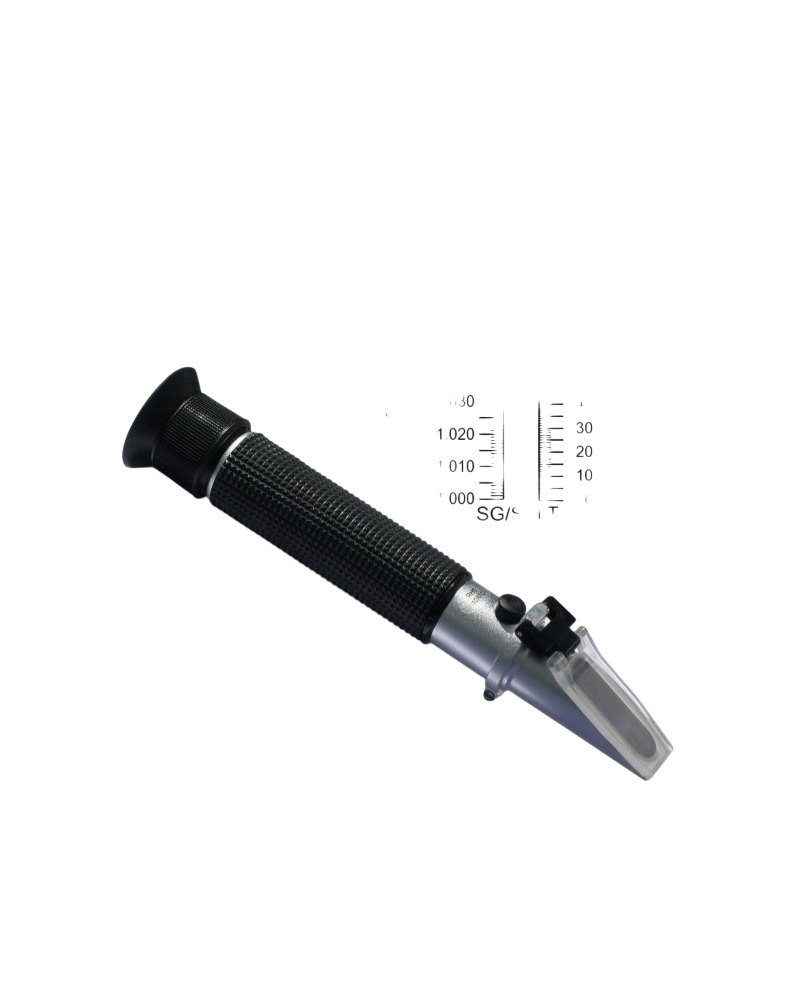



An aquaculture refractometer is a portable optical instrument used to quickly and accurately measure the salinity of water (salt content) where fish, shrimp, or other aquatic organisms are raised. It is an essential tool for water quality monitoring in aquaculture.
Principle: the refractometer measures the refractive index of a water sample, which changes with the concentration of dissolved salts.
Display: the measurement is read directly on a scale visible through the eyepiece, usually in ppt (parts per thousand) or ‰ (per mille).
Use: just place a few drops of water on the prism, close the cover plate, and look through the eyepiece
An aquaculture refractometer is a portable optical instrument used to quickly and accurately measure the salinity of water (salt content) where fish, shrimp, or other aquatic organisms are raised. It is an essential tool for water quality monitoring in aquaculture.
Principle: the refractometer measures the refractive index of a water sample, which changes with the concentration of dissolved salts.
Display: the measurement is read directly on a scale visible through the eyepiece, usually in ppt (parts per thousand) or ‰ (per mille).
Use: just place a few drops of water on the prism, close the cover plate, and look through the eyepiece
The refractometer is a measuring instrument used to determine the refractive index of transparent liquids by refractometry. It relies on the behavior of light.
If the general composition of a liquid is known, a refractometer can be used to measure the concentration of dissolved substances, for example the salt content in water.
It is an optical precision instrument for measuring salt content, with measurements performed in just a few seconds. Results can be read in absolute concentration (ppt) or specific gravity (kg/l). Supplied with a pipette and calibration accessory.
| Reference | Name | Measuring range | Size (mm) | Weight |
| P0087010 | Réfractomètre | 1.000 ... 1.070 / 0 ... 100 ppt | 200 - Ø40 | 0.27 |
Quick monitoring of salinity in the field.
Essential tool to adjust water conditions and ensure fish or shrimp health.
Portable, lightweight, and robust, suitable for use directly in ponds, tanks, or laboratories.