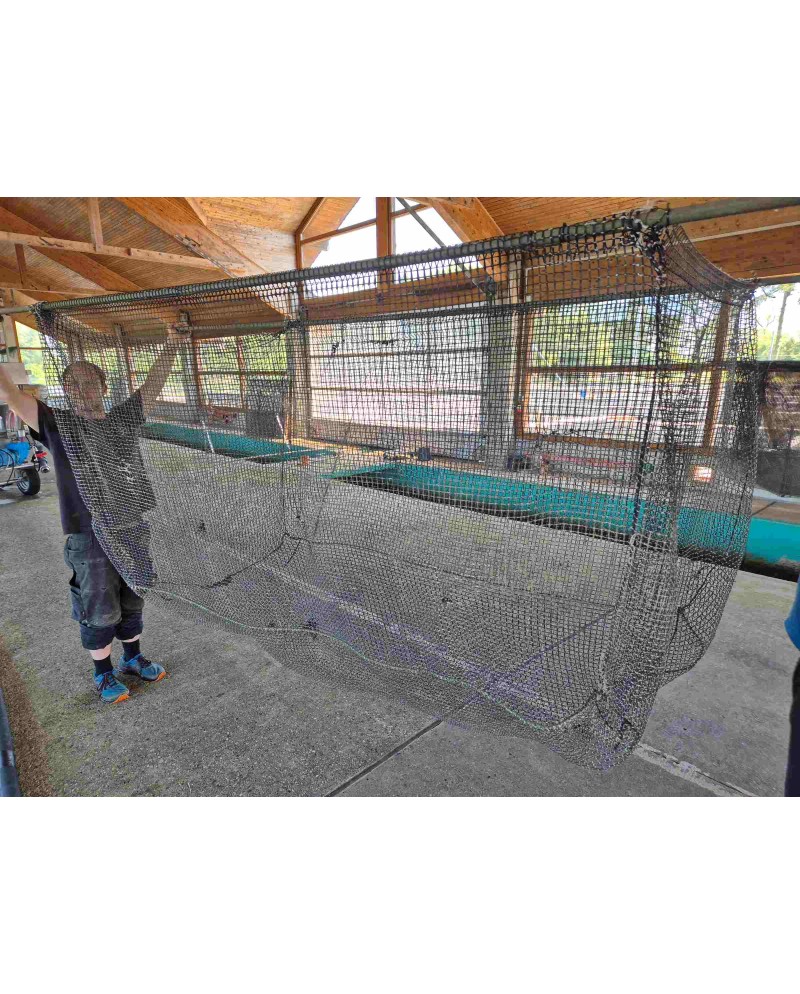


Material: polyester textile with polymer coating. Rigid, maintains its shape, smooth surface reduces fouling and/or facilitates cleaning.
Delivered in raw material as rolls or cut to size.
| Material PES | |||
| Models | Cutm² | ||
| 1 | M0212100 | Roll 2.5 x 2.5 mm, Width 3.7 m, green, par m² | |
| 2 | M0212200 | Roll 4.0 x 6.0 mm, Width 3.6 m, blue, par m² | |
| 3 | M0212250 | Roll 4.0 x 7.0 mm, Width 3.6 m, black, par m² | |
| 4 | M0212275 | Roll 10.0 x 10.0 mm, Width 3.8 m, black, par m² | |
| 5 | M0212400 | Roll 20.0 x 20.0 mm, Width 5.0 m, black, par m² | |
| Rolls | |||
| 6 | M0214100 | Roll, 2.5 x 2.5 mm, Width 3.7 m, green | |
| 7 | M0214200 | Roll, 4.0 x 6.0 mm, Width 3.6 m, blue | |
| 8 | M0214250 | Roll, 4.0 x 7.0 mm, Width 3.6 m, black | |
| 9 | M0214275 | Roll, 10.0 x 10.0 mm, Width 3.8 m, black | |
| 10 | M0214400 | Roll, 20.0 x 20.0 mm, Width 5.0 m, black |
Anchored to the bottom (ropes, chains, poles, or concrete blocks) to prevent drifting.
Modular cages can be connected in batteries or groups.
Adjustable height depending on water level and hydrodynamic conditions.
Suitable species: trout, carp, tilapia, sea bass, sea bream, etc.
Environment: pond, reservoir, lake, or calm coastal area.
Management:
Manual or automatic feeding.
Monitoring of stocking density, water quality, and net condition.
Regular cleaning to avoid clogging.
Advantages:
Simple, modular installation.
Good oxygenation due to water exchange.
Moderate cost compared with stainless-steel cages.
Limitations:
Biofouling risk, requiring frequent cleaning.
Shorter lifespan than rigid HDPE or steel structures.
Prone to tearing if not well maintained.