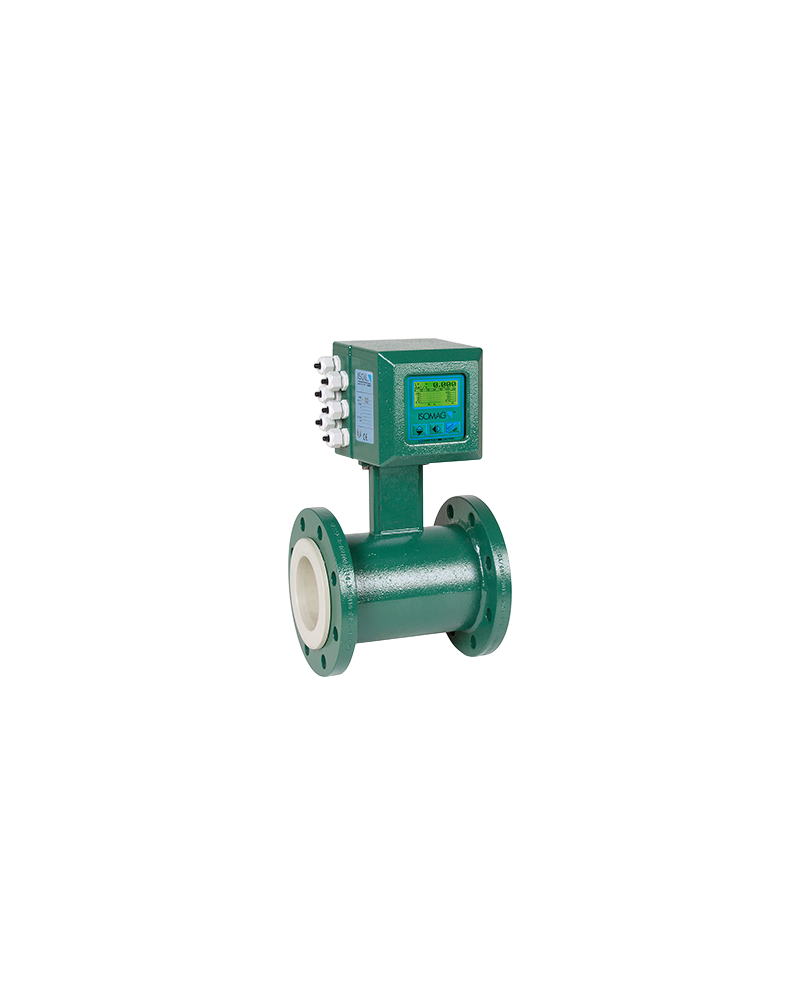

An electromagnetic flowmeter is a measuring device that determines the flow of a conductive fluid, such as water, by applying Faraday’s law.
When the fluid passes through a magnetic field, it generates an electrical voltage proportional to its velocity.
This voltage is detected by electrodes placed in the pipe.
The signal is then converted into volumetric flow (L/min, m³/h).
Accurate and with no moving parts, it is particularly suitable for aquaculture systems and hydraulic networks.
Operating principle
Based on Faraday’s law: when a conductive fluid (such as water) passes through a magnetic field, it generates an electrical voltage proportional to its velocity.
The electromagnetic flowmeter measures this voltage using electrodes placed inside the pipe.
The signal is then converted into volumetric flow rate (L/min or m³/h).
An electromagnetic flowmeter is a measuring device that determines the flow of a conductive fluid, such as water, by applying Faraday’s law.
When the fluid passes through a magnetic field, it generates an electrical voltage proportional to its velocity.
This voltage is detected by electrodes placed in the pipe.
The signal is then converted into volumetric flow (L/min, m³/h).
Accurate and with no moving parts, it is particularly suitable for aquaculture systems and hydraulic networks.
Operating principle
Based on Faraday’s law: when a conductive fluid (such as water) passes through a magnetic field, it generates an electrical voltage proportional to its velocity.
The electromagnetic flowmeter measures this voltage using electrodes placed inside the pipe.
The signal is then converted into volumetric flow rate (L/min or m³/h).
High accuracy: typically ±0.5% or better.
No moving parts: reduces wear and maintenance.
Suitable for large pipe diameters.
Reliable measurement even at low and variable flow rates.
Output: analog signal (4–20 mA), pulses, or digital communication (Modbus, Profibus, etc.).
Precise monitoring of water renewal in ponds and tanks.
Suitable for large-scale fixed installations (main pumps, water inlets).
Low maintenance compared to mechanical flowmeters.
Ideal for long-term monitoring and integration into automated systems