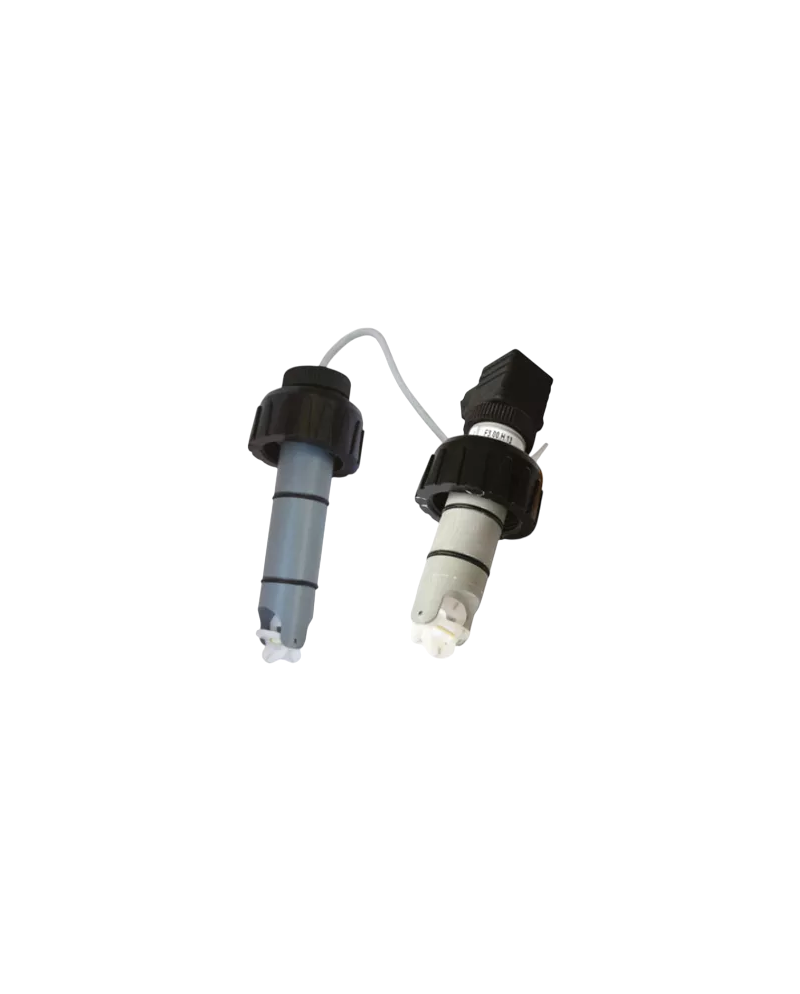

Paddlewheel flow sensor
A paddlewheel flowmeter (sometimes called an impeller flowmeter or flow paddlewheel sensor) is a simple and robust device often used in aquaculture to measure the water flow in pipes supplying tanks or ponds. Here is a description adapted to the aquaculture context:
A small paddle wheel (impeller) is placed inside the pipe through which the water flows.
When water circulates, it makes the wheel rotate proportionally to the flow velocity.
The rotation speed is converted into an electrical signal (magnetic or optical pulses) sent to a display or controller.
From this signal, the volumetric flow rate (L/min or m³/h) is calculated.
Paddlewheel flow sensor
A paddlewheel flowmeter (sometimes called an impeller flowmeter or flow paddlewheel sensor) is a simple and robust device often used in aquaculture to measure the water flow in pipes supplying tanks or ponds. Here is a description adapted to the aquaculture context:
A small paddle wheel (impeller) is placed inside the pipe through which the water flows.
When water circulates, it makes the wheel rotate proportionally to the flow velocity.
The rotation speed is converted into an electrical signal (magnetic or optical pulses) sent to a display or controller.
From this signal, the volumetric flow rate (L/min or m³/h) is calculated.
Materials: technical plastics, stainless steel, or composites, resistant to freshwater and sometimes seawater.
Pipe diameters: typically DN 15 to DN 200 (and larger).
Measuring range: usually 0.3 to 10 m/s flow velocity.
Accuracy: ±1 to 2% of full scale depending on the model.
Output: pulses (Hz), 4–20 mA, or digital communication.
Monitoring water renewal in ponds or tanks (essential for oxygen supply and waste removal).
Pump control and anomaly detection (clogging, leakage, pump failure).
Automatic management: can be coupled with a PLC or oxygen regulation system.
Durability: less sensitive to water quality compared to more expensive electromagnetic flowmeters.