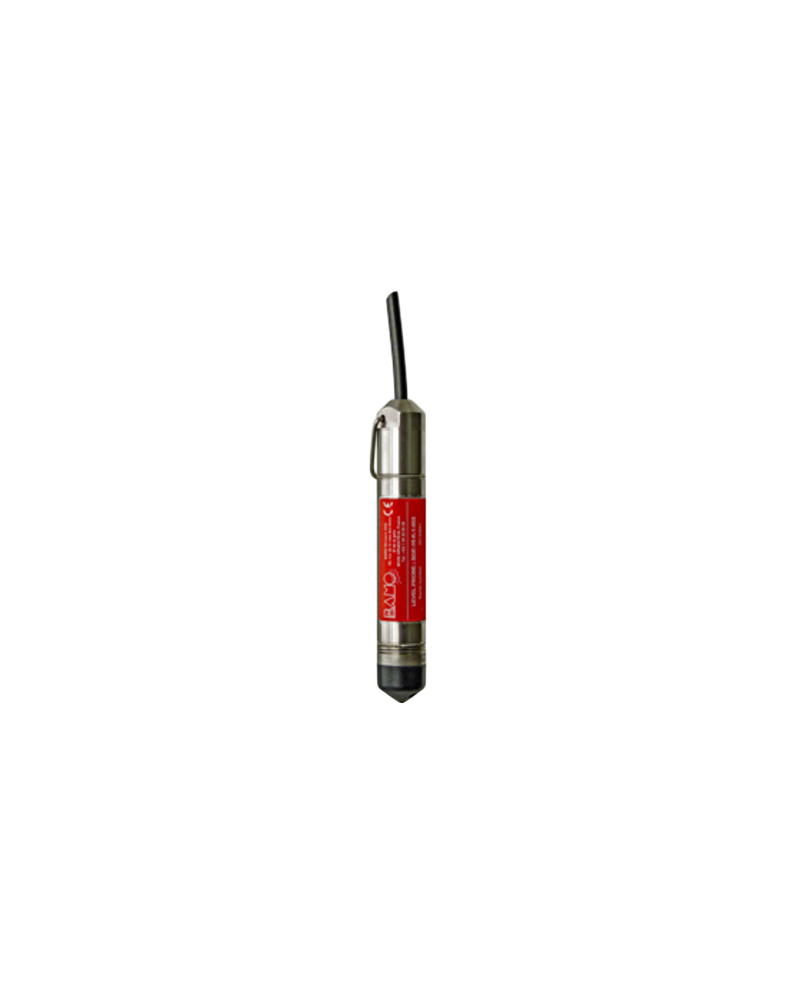

A hydrostatic level sensor for aquaculture is a device used to continuously measure the water level in a pond, tank, or reservoir based on the principle of hydrostatic pressure.
A hydrostatic level sensor for aquaculture is a device used to continuously measure the water level in a pond, tank, or reservoir based on the principle of hydrostatic pressure.
The sensor is immersed at a certain depth.
It measures the pressure exerted by the water column above it.
This pressure is proportional to the water height:
P=ρ⋅g⋅hP = \rho \cdot g \cdot hP=ρ⋅g⋅hwhere:
ρ\rhoρ = water density (kg/m³),
ggg = gravitational acceleration (9.81 m/s²),
hhh = water height (m).
The sensor converts this pressure into an electrical signal (4–20 mA, 0–10 V, or digital) that corresponds to the water level.
Measuring range: adapted to pond or tank depth (e.g., 0–5 m, 0–10 m).
Accuracy: ±0.1% to ±0.5% of full scale.
Materials: stainless steel, ceramic, or PVDF resistant to corrosion.
Protection rating: IP68 for continuous immersion.
Temperature compensation: corrects variations in water density due to temperature.
Output: analog (4–20 mA), digital (RS485/Modbus), sometimes wireless.
Real-time monitoring of water level in ponds, tanks, or recirculating systems.
Alerts in case of abnormal drops in level (leaks, pump failure).
Enables automation (pump or valve control).
Reliable and less affected by waves or turbulence compared to ultrasonic surface sensors.
.