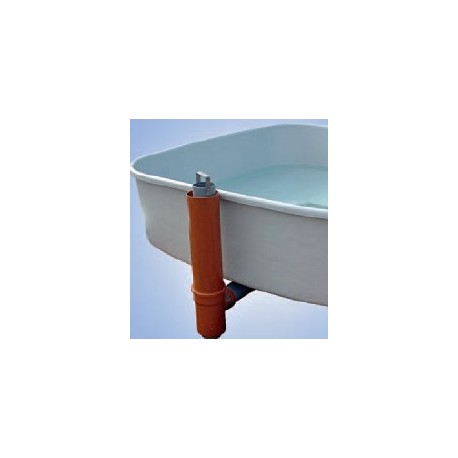


A telescopic drain (often called a telescopic pipe or sliding pipe stand) is a device commonly used in aquaculture to manage water levels, draining, and the removal of bottom water from ponds.
A telescopic drain (often called a telescopic pipe or sliding pipe stand) is a device commonly used in aquaculture to manage water levels, draining, and the removal of bottom water from ponds.
| Telescopic outlet | ||||
| Models | References | A (mm) | B (mm) | C (mm) |
| 1 | B0011100 | 110 | 110 | 50 |
| 2 | B0012100 | 110 | 110 | 63 |
| 3 | B0013100 | 110 | 160 | 75 |
| 4 | B0014100 | 160 | 160 | 90 |
| 5 | B0015100 | 160 | 160 | 110 |
A: Tank outlet
B: External pipe
C: Internal pipe
| Models |
Sloped drain with chain and safety hook | |
| 6 | B0016100 | DN100/110 mm |
| 7 | B0017100 | DN150/160 mm |
Definition and Operation
The telescopic drain generally consists of:
A vertical sliding pipe (often made of PVC) fitted into a fixed sleeve.
A low-level water intake or bottom screen connected to the system.
An adjustment valve or lever system that allows the sliding pipe height to be adjusted.
Principle:
By raising or lowering the sliding pipe, the water level in the pond can be controlled. Lowering it completely allows partial or complete drainage of the water, especially the bottom water, which is often more loaded with organic waste (feces, nutrients, etc.).
Advantages
Precise control of the water level.
Gravity-based discharge of loaded water.
Simple operation, no pump required for draining.
Less stress for the fish compared to abrupt draining.
Can be combined with screens or filters to retain the fish.