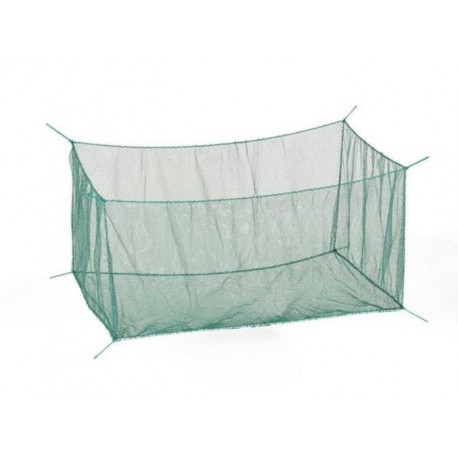




A net cage for aquaculture is a floating or submersible structure designed for fish farming in ponds, lakes, reservoirs, or coastal areas. It allows fish to be contained while letting water circulate freely, thereby ensuring oxygen supply and waste removal.
A net cage for aquaculture is a floating or submersible structure designed for fish farming in ponds, lakes, reservoirs, or coastal areas. It allows fish to be contained while letting water circulate freely, thereby ensuring oxygen supply and waste removal.
For storing fish after capture or sorting, made of polyamide material, complete with top rope and loops at all 8 corners.
| Models | Reference | Lenght - Width - Height | Mesh | Thread |
| 1 | M0181100 | 1.5 - 1.0 - 0.75 m | 4 mm | 210/6 |
| 2 | M0181200 | 1.5 - 1.0 - 0.75 m | 6 mm | 210/9 |
| 3 | M0181300 | 1.5 - 1.0 - 0.75 m | 10 mm | 210/15 |
| 4 | M0181400 | 2.0 - 2.0 - 1.5 m | 10 mm | 210-15 |
| 5 | M0181500 | 2.5 - 2.0 - 2.0 m | 10 mm | 210/15 |
| 6 | M0181600 | 3.0 - 3.0 - 2.0 m | 10 mm | 210/15 |
Advantages
Allows natural water circulation, ensuring oxygenation and waste dispersion.
Easy transport and installation, adjustable according to cage size and number.
Reduces stress for fish thanks to a confined but well-ventilated space.
Protection against predators and fish escape.
Disadvantages
Requires regular maintenance: cleaning of algae and biofilm.
Sensitive to weather conditions (strong winds, waves).
Risk of net tearing or wear depending on fish density and behavior.
Applications
Freshwater or marine fish farming: tilapia, trout, salmon, carp.
Experimental or research tanks.
Marine or lagoon aquaculture.