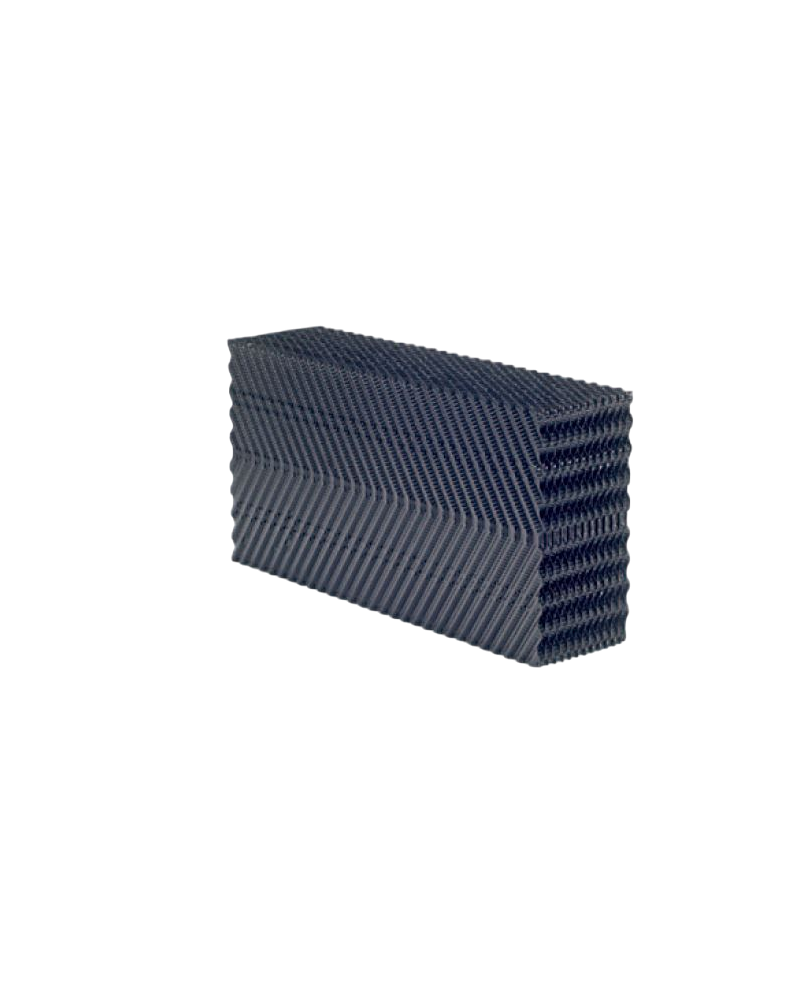



In aquaculture, the fixed substrate (or fixed media) is a solid, immobile support designed to promote the colonization of nitrifying bacteria and to enhance gas exchange in recirculating systems or grow-out tanks.
Biofiltration
The fixed substrate provides a large specific surface area for the growth of autotrophic bacteria (Nitrosomonas, Nitrobacter, Nitrosospira).
These microorganisms convert toxic ammonia (NH₃/NH₄⁺) and nitrite (NO₂⁻) into less harmful nitrate (NO₃⁻).
The support ensures stable and continuous biological purification through biofilm attachment.
Water Degassing
Water flowing through the substrate enhances air–water contact, enabling the removal of carbon dioxide (CO₂) and other dissolved gases (nitrogen, H₂S).
This passive aeration helps to maintain pH balance and increase dissolved oxygen levels.
In aquaculture, the fixed substrate (or fixed media) is a solid, immobile support designed to promote the colonization of nitrifying bacteria and to enhance gas exchange in recirculating systems or grow-out tanks.
Biofiltration
The fixed substrate provides a large specific surface area for the growth of autotrophic bacteria (Nitrosomonas, Nitrobacter, Nitrosospira).
These microorganisms convert toxic ammonia (NH₃/NH₄⁺) and nitrite (NO₂⁻) into less harmful nitrate (NO₃⁻).
The support ensures stable and continuous biological purification through biofilm attachment.
Water Degassing
Water flowing through the substrate enhances air–water contact, enabling the removal of carbon dioxide (CO₂) and other dissolved gases (nitrogen, H₂S).
This passive aeration helps to maintain pH balance and increase dissolved oxygen levels.
For the biological treatment of effluent in fish farming. In practice, several biofiltration methods are used. All methods share the use of a substrate that provides a surface for bacterial colonization.
AK blocks for use in degassing columns, trickling filters, and submerged fixed-bed reactors, up to 12 m column height, excellent water distribution, and very long service life.
| Models | Reference | Name | Matérial | m2/m3 (*) |
Lenght - Width - Height (mm) (**) |
Speed max | Weight (kg/m3) |
| 1 | G0325100 | AK3-27 | PP | 125 | 2400-300-600 | 30 m3/m2/h | 25 |
| 2 | G0325200 | AK3-19 | PP | 152 | 2400-300-600 | 28 m3/m2/h | 23 |
| 3 | G0325300 | AK3-12 | PP | 240 | 2400-300-600 | 25 m3/m2/h | 31 |
| (*) specific surface | |||||||
| (**) Other sizes available on request | |||||||
Structure: rigid materials (plastic, ceramic, sintered glass, porous rock) arranged in fixed layers or blocks.
Specific surface area: typically 100–500 m²/m³, depending on the material.
Controlled porosity: allows efficient water flow without clogging.
Chemical inertness: does not alter pH or release compounds.
Easy maintenance: mechanical cleaning or backwashing possible.
Durability: long service life, resistant to wear and temperature variations.
Trickling filters or percolating biofilters.
Degassing or denitrification towers.
Fixed-bed bioreactors in RAS (Recirculating Aquaculture Systems).
Pre-treatment or polishing tanks to improve water quality before discharge or reuse.